
Why Cordless Blinds Are Force-Balance Systems, Not Fabric Products
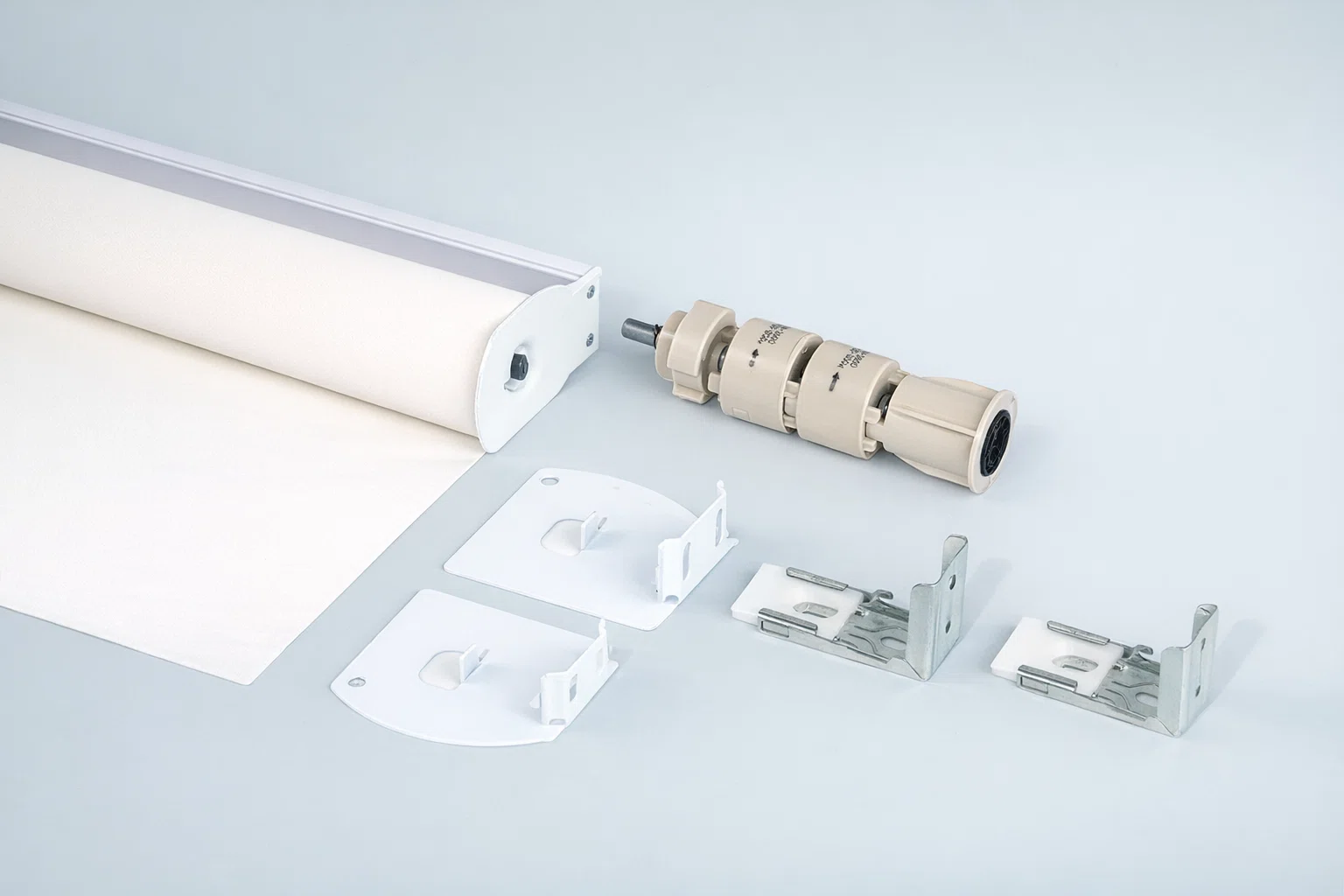
Cordless blinds fail not because the fabric is wrong,
but because the force balance collapses.
Once you stop treating them like textile products,
their behavior becomes predictable.
Quick Summary
Cordless blinds are often marketed as simplified window coverings,
but mechanically they are force-balance systems.
Gravity, stored energy (spring or assist), and braking must remain matched
within a narrow stability band.
When this balance drifts—due to size, aging, or tolerance accumulation—
problems like uneven lift, drift, noise, and “heavy feel” are inevitable.
Understanding cordless blinds as machines, not fabrics,
is the foundation for reliable design and evaluation.
1) The Fundamental Misconception: “It’s Just Fabric Without Cords”
| Evaluation Logic | Fabric-Centric View | Force-Balance System View |
|---|---|---|
| Primary focus | Material, texture, stacking | Force equilibrium across travel |
| User role | Active force control | Passive observer |
| Failure interpretation | Fabric or installation issue | Force band collapse |
| Scalability sensitivity | Low | High (width amplifies error) |
Many cordless blinds are still evaluated as if they were corded products
with the cords simply removed.This mental model is misleading—and expensive.
In a corded blind, the user is part of the control loop.The user supplies energy, senses resistance, and unconsciously compensates for internal inconsistencies.Minor friction changes, tolerance drift, or asymmetry are often masked by human input.
A cordless blind has no such safety net.Once the cords are gone, the system must regulate itself.
At that moment, the product stops behaving like a textile assembly and starts behaving like a mechanical force-balance system.
In cordless designs, the user no longer controls force.
The system must continuously balance it on its own.
2) What “Force Balance” Actually Means in Cordless Blinds
A force-balance system is stable only when opposing forces remain matched
across the full range of operation.
In cordless blinds, this balance is never static—it must be maintained
at every lift height and throughout the product’s lifecycle.
| Force Balance Condition | User Perception | Typical Field Description |
|---|---|---|
| Balanced (±5%) | Light, controllable | “Feels stable at any height” |
| Spring-dominant | Aggressive, rebound-prone | “Jumps up near the top” |
| Brake-dominant | Heavy, sticky | “Feels heavier than before” |
| Unstable band | Inconsistent | “Only works well in the middle” |
2.1 The three forces that define system behavior
- Gravity load —
the combined weight of fabric, bottom rail, and internal components,
always acting downward. - Stored energy output —
typically a constant-force spring or spring-assist mechanism,
providing upward counterforce. - Braking / damping force —
governing motion, preventing runaway, and stabilizing position.
These forces must coexist within a narrow operating window.
If the spring output is too low, the blind drifts downward.
If it is too high, the blind feels aggressive, rebounds, or becomes noisy.
If braking authority is mismatched, motion becomes unstable.
This is why cordless blinds should always be evaluated
as force-balance mechanical systems,
not as decorative coverings.
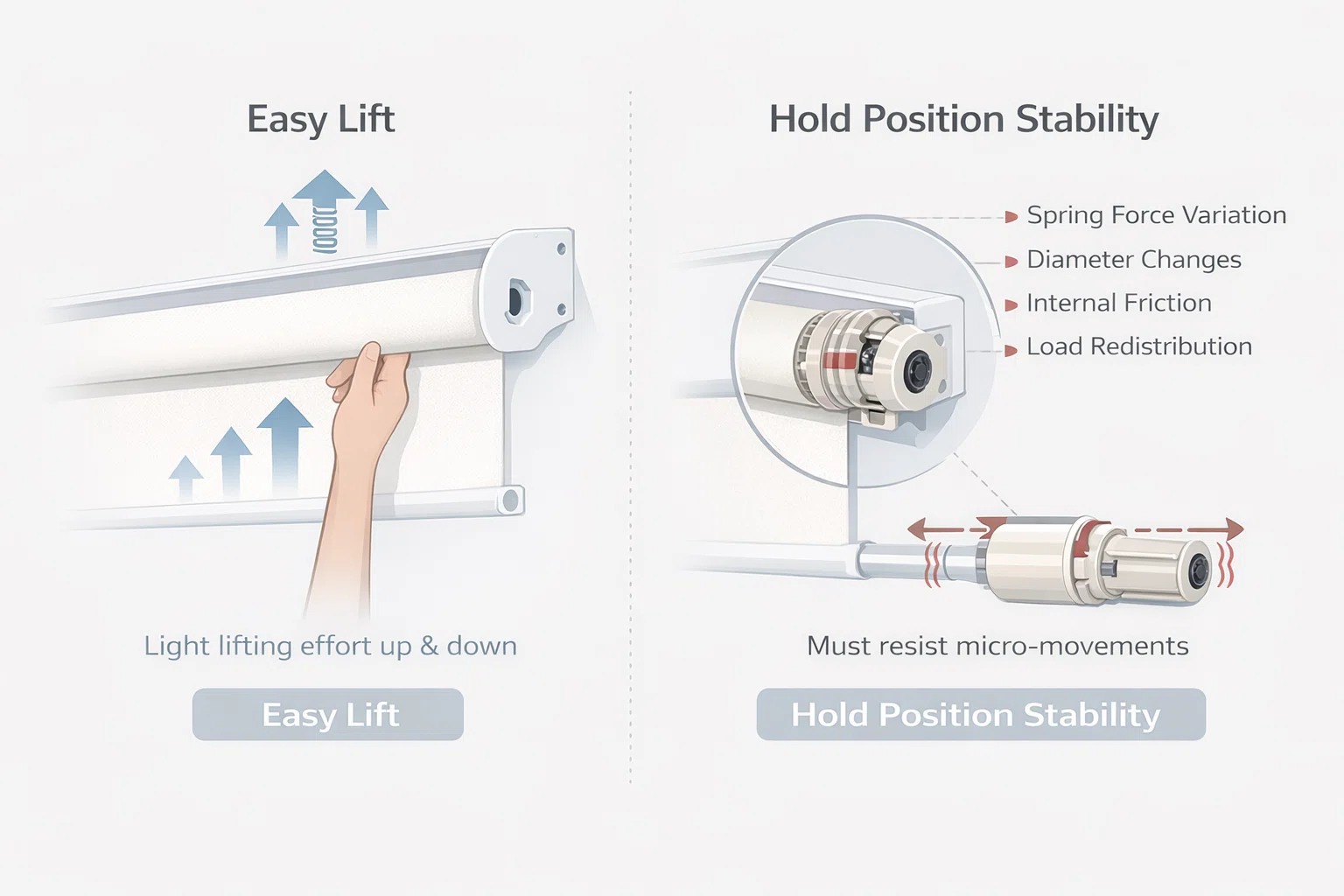
3) Why “Lift” Is Easy — and “Hold” Is Hard
Marketing materials often focus on lift effort:how light the blind feels when pulled up or down.
Engineers focus on something else entirely: hold stability.
Holding position means the system must resist micro-movements caused by:
- spring force variation across travel
- spool diameter changes
- internal friction gradients
- load redistribution in wide platforms
In a true force-balance system, the blind can stop at any height
and remain there without creeping, rebounding, or requiring correction.
Achieving this requires not just sufficient braking,
but a stable force band defined primarily by the spring.
If a system only feels stable in the middle of travel,
it does not have a wide balance band—it has a narrow one.
4) Why Fabric Quality Rarely Causes Cordless Failures
When cordless blinds fail in the field,
the instinctive reaction is often to blame fabric:
stretching, stacking behavior, or material inconsistency.
In practice, fabric is almost never the root cause.Fabric is a passive load.
It does not decide whether a blind drifts, tilts, or makes noise.
Those behaviors originate upstream:in spring output consistency,braking stability,
and how these interact as the system ages.
Treating cordless failures as “fabric issues”
delays corrective action and obscures the real problem:
a force-balance system operating outside its stable window.
5) Why Size and Time Reveal the Truth Faster
Two variables expose force-balance weaknesses more reliably than any lab test:
width and time.
5.1 Width amplifies imbalance
| Blind Width | Torque Mismatch Visibility | Typical Field Risk |
|---|---|---|
| ≤ 1.2 m | Low | Minor drift often unnoticed |
| 1.5–2.0 m | Moderate | Uneven lift under aging |
| ≥ 2.5 m | High | Visible tilt, noise, recall risk |
As width increases, the bottom rail becomes a longer lever arm.
Small left–right differences in torque or friction
become visible tilt and uneven lift.
What a narrow blind hides, a wide blind reveals.
5.2 Time erodes assumptions
Over months and cycles:
springs relax,
friction interfaces evolve,
and lubrication migrates.
If spring and brake were tuned independently,
their behavior diverges—and the original balance collapses.
This is why systems that feel “perfect” at installation
can develop issues 12–18 months later.
The failure was not random; it was latent.
| Lifecycle Stage | What Changes | Observed Effect |
|---|---|---|
| 0–3 months | Low friction, full spring output | “Very smooth” |
| 6–12 months | Spring relaxation, wear-in | Heavier feel, minor drift |
| 12–24 months | Friction migration, mismatch | Noise, tilt, complaints |
6) The Correct Mental Model for Evaluating Cordless Designs
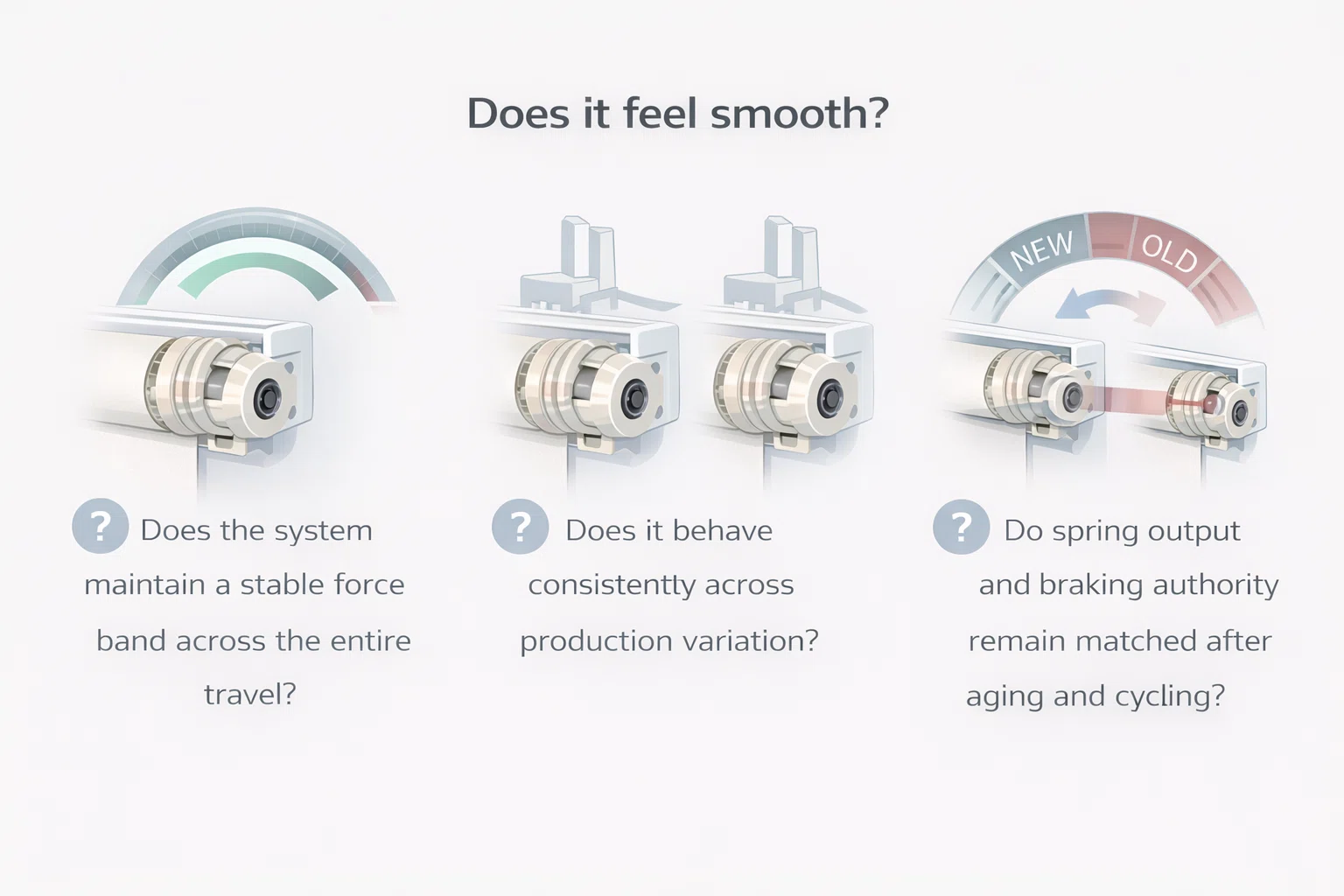
To evaluate a cordless blind correctly,replace the question:
“Does it feel smooth?”
with three engineering questions:
- Does the system maintain a stable force band
across the entire travel? - Does it behave consistently across production variation?
- Do spring output and braking authority remain matched
after aging and cycling?
These questions form the foundation of
a reliable cordless mechanical system,
as outlined in the Pillar overview on force-balance architecture.
FAQ
Q1: Are all cordless blinds force-balance systems?
Yes. Regardless of whether the system is spring-driven, motor-assisted, or hybrid, any cordless blind must continuously counter gravity and regulate motion without user-supplied energy.
Q2: Can better fabric compensate for poor force balance?
No. Fabric is a passive load.
It affects appearance and stacking, but it cannot correct torque mismatch, brake instability, or spring aging.
Q3: Why do some cordless blinds only fail near the top or bottom?
Because force balance is rarely uniform across travel.
Spool diameter changes, friction zones, and spring characteristics create weak stability regions, which are exposed first at travel extremes.
Q4: Is “smooth operation” a reliable engineering metric?
No. Smoothness reflects initial friction, not system stability.
A reliable cordless system must remain stable across full travel, across production variation, and after aging.
Q5: Why do wider blinds expose problems faster?
Width turns the bottom rail into a longer lever arm.
Small left–right torque differences that are invisible at 1.2 m become obvious tilt, noise, and drift at 2.5 m and above.
Q6: Can stronger braking fix force imbalance?
Only temporarily.
Increasing brake friction may mask instability short-term, but it often leads to heavy feel, stick-slip noise, and accelerated wear.
Force balance must be corrected at the spring level first.
Q7: Why do some blinds feel fine at installation but fail months later?
Because spring output and braking were tuned independently.
As springs relax and friction evolves over time, the original balance collapses—revealing latent instability 12–18 months later.
Q8: Is spring force consistency more important than peak force?
Yes.
Cordless reliability depends far more on force stability across travel (±5% band) than on maximum lifting capability.
Q9: Are motorized cordless blinds also force-balance systems?
Yes.
Motors change the energy source, not the physics.
Gravity still acts, braking still governs motion, and imbalance still produces noise, drift, and uneven behavior.
Q10: What is the correct way to evaluate a cordless blind system?
Replace “Does it feel smooth?” with three questions:
Does it maintain a stable force band across the entire travel?
Is behavior consistent across production units?
Do spring output and braking authority remain matched after aging and cycling?
Field Insight
The most expensive mistake in cordless development
is treating a force-balance problem as a fabric problem.
Once you view cordless blinds as mechanical systems,
the symptoms—drift, tilt, noise, heavy feel—stop being mysteries.
They become signals that the balance band has collapsed.
Wide sizes and long-term use simply expose that truth faster.