
Cordless as a Mechanical System: Why “Smooth” Is Not the Same as “Reliable”
Cordless blinds are not “fabric products with a nicer handle.”
They are force-balance machines.
Once you treat them like machines, the failure modes stop looking random—and start looking predictable.
Quick Summary
A cordless shade is fundamentally a force-balance system: stored energy (spring or motor assist) must continuously counter gravity while a brake governs motion inside a narrow stability band.
This is why large sizes expose issues early—width turns the product into a lever-driven platform that amplifies small torque or friction mismatches.
And this is why “smooth operation” is not proof of reliability: day-one smoothness can be created by low friction, while long-term stability depends on how spring output, brake authority, and aging behaviors stay matched over time.
Table of Contents
1) Why Cordless Is a Force-Balance System (Not a Fabric Product)
In a corded blind, the cord is your “control interface.” The user supplies the energy, and the cord path provides mechanical advantage.
The system can tolerate a surprising amount of internal inconsistency because the user unconsciously compensates.
In a cordless blind, that safety net is gone.
The system must:
(a) store or provide energy to counter gravity,
(b) release that energy smoothly when the user moves the bottom rail,and
(c) hold position at any height without drifting.
That is a textbook force-balance problem.
A cordless unit is stable only inside a narrow band where:
spring output (or assist torque) and gravity load are matched,
while braking authority governs motion to prevent runaway, rebound, or creep.
1.1 The three forces you can’t ignore
- Gravity load (fabric + bottom rail + internal mass): constant direction, predictable magnitude.
- Energy source (spring / hybrid spring-assist / motor assist): provides counteracting torque or pull force.
- Brake / damping: does not create force; it regulates motion and stabilizes position.
If you remember only one sentence, remember this:
The spring sets the force band; the brake governs motion inside that band.
When the band itself is wrong (or drifts with aging), the brake cannot “fix” it—at best it can hide it temporarily.
1.2 Why “hold position” is the hardest requirement
Many product pages talk about lift and lower. Engineers worry about hold.
Holding position across the full travel means the system must resist micro-movements caused by:
internal friction variations, spool diameter changes, spring relaxation, and load redistribution.
A reliable cordless system behaves like a stable platform: you can stop anywhere, and it stays there without needing the user to “babysit” it.
That stability is not luck—it comes from a matched force band and controlled braking behavior across the entire stroke.
If your design only “feels good” at mid-height but drifts near the top or bottom, you don’t have a smooth system—you have a narrow stable window.
2) Why Bigger Sizes Expose Problems
The most common misconception is that a bigger blind is just “more fabric.”
In reality, increasing width transforms the system into a lever-driven mechanical platform.
The bottom rail becomes a longer lever arm, and tiny left-right differences become visible tilt.
 |
 |
2.1 Width is a force amplifier
On a narrow shade, small torque mismatch between left and right sides may be absorbed by the structure or unnoticed by the user.
On a wide shade, that mismatch becomes a measurable angular deviation:
one side lifts slightly faster, stacking shifts, and the bottom rail tilts.
- Small mismatch → amplified tilt
- Small friction difference → asymmetric motion
- Minor tolerance drift → visible uneven lift
2.2 “But it passed testing” is not the same as “it scales”
Many systems look fine in a single-size lab sample.
Scaling exposes what was hidden:
the force band that was “close enough” at 1.2 m becomes unstable at 2.4 m because the platform sensitivity increases.
This is why professional engineering teams treat width as a threshold variable, not a cosmetic dimension.
Past a certain size, you are no longer validating a product—you are validating a platform.
2.3 The hidden culprit: left-right reference points
In wide cordless blinds, the tube ends and the bottom-rail ends become torque reference points.
Any difference in spring output, brake behavior, or friction path shows up as left-right mismatch.
Installer tweaks can correct static alignment, but they cannot correct dynamic imbalance that changes across travel.
3) Why “Smooth” ≠ “Reliable”
“Smooth operation” is one of the most overused phrases in window coverings.
It sounds like quality, but it’s often just a description of low day-one friction.
The problem: friction is not stable over time.
3.1 Smoothness can be faked by low friction
A system can feel smooth on day one if the friction interfaces are low and the initial force band is generous.
But low friction does not guarantee:
position stability, noise control, or aging robustness.
3.2 Reliability is about behavior after aging, not behavior at unboxing
Over months and cycles, three things happen in almost every real-world environment:
- Spring output decays (relaxation / set / fatigue characteristics)
- Friction interfaces change (wear-in, contamination, surface polishing, stick-slip zones)
- Lubrication migrates or disappears (temperature cycles, dust, material compatibility)
If spring and brake were tuned independently, their aging curves can diverge.
The system that was balanced at assembly is no longer balanced in the field.
That’s when “it used to be smooth” becomes “it’s heavy,” “it drifts,” or “it makes noise near the top.”
Smooth feel is a snapshot. Reliability is a curve (over travel and over time).
4) How to Read Field Symptoms Like an Engineer
End users report symptoms. Engineers map symptoms to root causes.
Below is a simple translation table you can use when analyzing competitor products—or your own returns.
| Field Symptom | What It Often Means | System-Level Root Cause |
|---|---|---|
| “Feels heavier than before” | More resistance is required to move | Brake friction drift and/or spring output loss collapsing the balance band |
| “Doesn’t stop where I leave it” | Position instability / creep | Insufficient brake authority or force band mismatch at specific travel zones |
| “Bottom rail tilts / uneven lift” | Left–right imbalance amplified by width | torque mismatch, asymmetric friction paths, tolerance stacking at platform scale |
| “Noise near the top” | Stick-slip / micro-corrections / interface chatter | brake zone instability under changing spring force and spool geometry |
5) Design Checkpoints That Actually Predict Reliability
If you are evaluating platforms, suppliers, or competitor designs, don’t start with marketing language.
Start with checkpoints that correlate with real field performance:
5.1 Validate across the full travel (not a single pull test)
A cordless platform can behave differently at the top, mid-height, and full drop.
You need to understand the force band across travel—not just the force at one point.
5.2 Validate across production (not one perfect sample)
A “great sample” is meaningless if unit-to-unit variation is wide.
Wide blinds amplify small deviations, so repeatability becomes a primary quality metric.
5.3 Validate after aging (because aging is guaranteed)
Springs relax. Friction changes. Lubrication moves.
A platform is reliable when spring output and brake authority stay matched as these changes occur.
If your reliability plan is “we’ll increase friction to compensate,” you’re borrowing time from your warranty budget.
Deep Dives (Cluster Articles)
This Pillar page is the system-level framework. If you want the technical deep dives, start here:
- Why Cordless Blinds Are Force-Balance Systems, Not Fabric ProductsDefines the system architecture and explains how energy, load, and governance interact.
- From Window Covering to Mechanical PlatformMoves from product thinking to platform thinking: scaling, aging, and risk control.
If you’re building a reliability-focused content hub, you can treat this Pillar as the “home base.”
Each deep dive should link back here using natural anchor text like
cordless mechanical system, force-balance architecture, or why smooth isn’t reliability.
FAQ
Q1: If a cordless blind feels smooth, doesn’t that prove it’s well engineered?
Not necessarily. Smooth feel can come from low friction, which may change dramatically with wear-in and environmental exposure.
Reliability requires stable behavior across travel and after aging—not just a good first impression.
Q2: Why do wide blinds show uneven lift more often?
Width increases platform sensitivity. The bottom rail becomes a longer lever arm, so tiny left–right differences in torque or friction become visible tilt.
What a narrow blind “hides,” a wide blind “magnifies.”
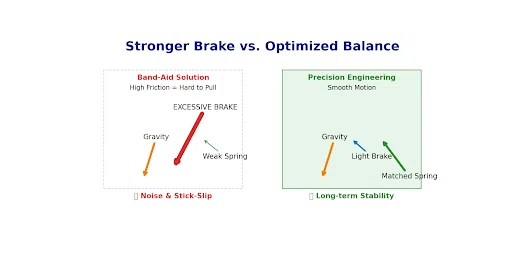
Q3: Can a stronger brake solve drifting or sagging?
It can sometimes mask the symptom short-term, but it often increases pull force and raises the risk of stick-slip noise.
Long-term stability comes from correcting the force band first, then governing motion within it.
Q4: Why do some systems fail only near the top or bottom?
Spool geometry, friction zones, and spring output can vary across travel.
Many designs have only a narrow stability window—outside that window you get creep, rebound, or chatter.
Q5: What’s the single most common “hidden” cause of failures after 12–18 months?
Aging curve divergence: spring output decays while friction behavior changes.
If spring and brake were tuned independently, the original balance collapses over time.
Q6: Is cordless engineering harder than motorized?
Pure motorized systems shift the problem to motor control and power. Cordless mechanical systems must achieve stability with passive mechanics,
which makes the force-balance and aging behavior especially critical.
Q7: What should OEMs ask suppliers to prove platform stability?
Ask for validation across full travel, across production variation, and after aging / lifecycle testing.
A single pull-force number is not enough.
Q8: Why do some blinds become noisy only after months of use?
Noise often comes from stick-slip behavior at friction interfaces.
As surfaces wear and lubrication changes, micro-corrections can turn into audible chatter—especially near travel extremes.
Field Insight
If you want to “think like a Tier-1 platform engineer,” stop judging cordless systems by how they feel on day one.
Judge them by whether they remain a force-balance system after real-world aging:
spring output drift, friction evolution, and lubrication migration are not exceptions—they are the normal lifecycle.
Wide blinds simply reveal the truth faster because they amplify mismatch.
In other words: smoothness is a snapshot; reliability is a curve.