
Cordless Window Coverings in 2026: Engineering Trends Shaping the US Market
 Post-regulation, the US cordless market has moved from “cord-free” to “premium-performance.”
In 2026, brands win on quiet operation, large-size stability, and verified lifecycle reliability—not on a cordless label.
This article continues our 2026 engineering series. If you missed the earlier posts this week, start here:
Why a $0.50 Cheaper Spring Can Cost $50 Later,
and Why Cordless Reliability Depends on Spring–Brake Synergy.
Quick Summary
- 2026 buyers expect “quiet + large + long-life”, not just cordless compliance.
- Variable/tapered spring geometry is becoming the go-to path for constant pull feel on extra-wide shades.
- Friction control + ultra-quiet braking now defines perceived quality (squeak/chatter = brand damage).
- Lifecycle proof beats claims: 10,000+ cycle targets, plus heat/humidity/salt exposure verification.
- Smart-home still needs mechanics: spring-assisted motorization reduces peak load and stabilizes motion.
Intro |
1) Variable Diameter Springs |
2) Quiet Braking |
3) Predictive Durability |
4) Smart + Mechanical |
Conclusion |
FAQ |
Field Insight
Introduction: The US Market Has “Settled”—Now It’s Upgrading
The 2024–2025 period in the US window coverings space was a digestion phase: portfolios were cleaned up,
cordless architectures became the default, and supply chains reorganized around safer designs.
By 2026, the conversation has shifted again.
Consumers (and retailers) are no longer satisfied with “it works.” They are buying (and reviewing) based on:
quiet motion, large-size stability, and long-term consistency.
That means the competitive edge is no longer a feature checkbox—it’s engineering depth, validation, and repeatability.
This article focuses on the latest breakthroughs in spring-driven + braking systems—and how US brands can
turn engineering capability into measurable market advantage.
1)The Rise of Variable Diameter Spring TechnologyTraditional equal-diameter spring solutions often struggle as shade size grows:
the system can feel “light” in one part of travel and “heavy” in another.
On extra-wide or heavier fabrics, that uneven feel becomes a returns driver—not a minor annoyance.
Why “Equal Geometry” Fails on Oversized Shades
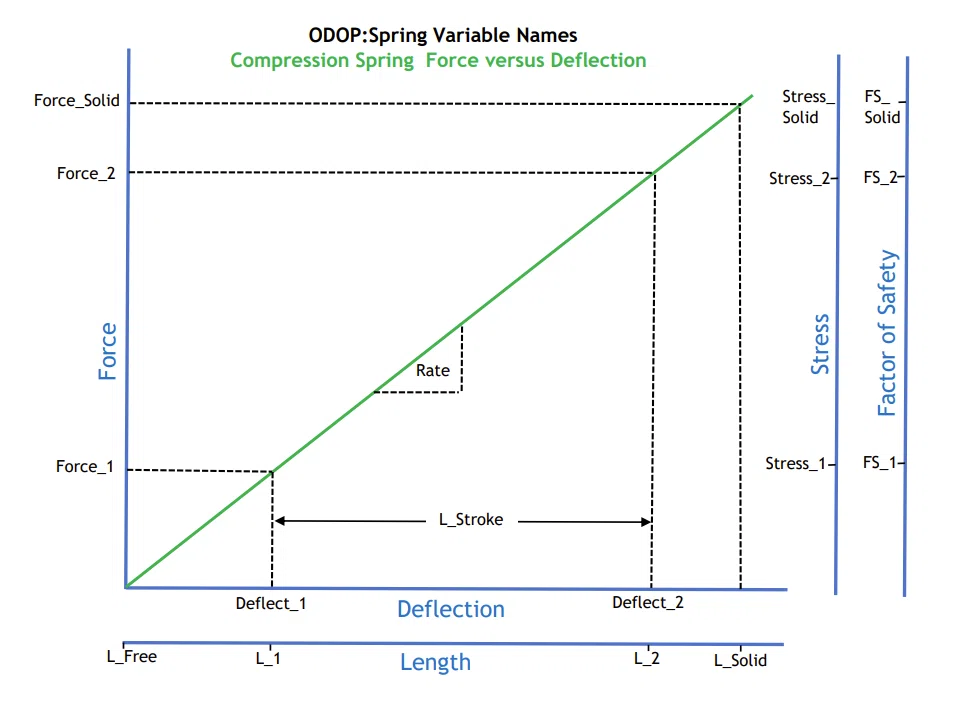
- Torque band mismatch: the spring’s output curve does not match the load curve across travel.
- Force drift sensitivity: small aging changes create big feel differences
- Top-end shock risk: excess stored energy can release too fast near the top without strong damping.
2026 Trend: Tapered / Variable Springs for “Constant Pulling Force”
Variable-diameter (tapered/conical) geometry is being adopted to flatten the perceived pull-force curve,
especially in large-format cordless platforms. The aim is simple:
consistent hand feel from first pull to last inch.
| Engineering Topic | Equal-Diameter Spring Approach | Variable/Tapered Spring Approach (2026) | What It Buys You (B2B Value) |
|---|---|---|---|
| Hand feel stability | Often “heavy zone + light zone” | Flatter pull-force profile across travel | Higher satisfaction on wide SKUs; fewer “feels wrong” returns |
| Oversize capability | Needs aggressive tuning; narrow safety window | Wider tuning window; better load matching | More reliable cordless for large openings (floor-to-ceiling) |
| Top-end behavior | Higher slam-up risk if damping is weak | Curve shaping reduces peak energy release | Lower noise/impact complaints; fewer warranty tickets |
| Aging sensitivity | Small drift can push system out of balance | More tolerant to gradual force decay | Better year-2 consistency |
How US Brands Should Specify It (Simple but Non-Negotiable)
- Define the acceptable pull-force band (e.g., target range + max deviation across travel).
- Require force-curve reporting over travel—not just a single-point pull number.
- Ask for aging drift projection (even a simplified model beats “no model”).
If you only measure “pull force at full drop,” you are blind to where premium customers complain:
mid-travel feel, near-top noise, and long-term drift.
2) Friction Control & Ultra-Quiet Braking Mechanisms
In 2026, “quiet” is no longer a nice-to-have. It is a brand signal.
A cordless shade that squeaks, chatters, or knocks near the top instantly reads as “cheap,” even if it is technically safe.
 |
|
Where Noise Really Comes From (Field Reality)
- Stick-slip at friction interfaces (“squeak” under intermittent motion).
- Micro-oscillation from runout/tolerance stack (“chatter” during lift).
- End-stop impact when damping authority is insufficient (“knock” at the top).
Materials Are the Quiet Multiplier
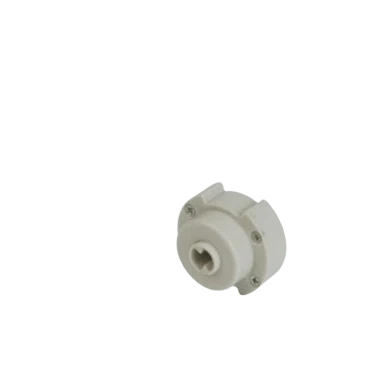
High-performance brake materials are increasingly used to stabilize friction coefficients and suppress noise.
Typical directions include self-lubricating composites and fiber-reinforced polymers
designed to reduce stick-slip and maintain consistent contact behavior under heat and wear.
2026 Highlight: Bi-Directional Clutch / Bi-Directional Braking for Zero-Drift
The best “premium-feel” platforms treat braking as a two-way control problem:
controlled resistance during pull-down, and controlled release during rise-up.
A bi-directional architecture helps keep shades stable at any position—without relying on “friction luck.”
| Design Element | What It Controls | Failure Mode If Weak | What “Premium” Looks Like |
|---|---|---|---|
| Friction interface pair | Torque stability + noise behavior | Squeak / grab-release / drift | Stable friction coefficient; low stick-slip sensitivity |
| Preload control | Brake authority margin | Mid-height creep; inconsistent hold | Defined adjustment method; repeatable torque band |
| Bi-directional control | Pull-down feel + rise-up damping | Top slam-up; rebound; “overrun” | Zero-drift positioning with controlled rise speed |
| Anti-chatter guidance | Micro-oscillation suppression | Chatter noise; accelerated wear | Guided contact geometry; reduced sensitivity to runout |
This is why spring + brake must be engineered together, not tuned independently.
If you tune them separately, their aging curves diverge—and the system collapses later
3) Predictive Durability: Digital Verification of Spring Life-cycles
The market is demanding proof. In 2026, many brands are raising internal durability gates from
“passes a basic functional test” to “verified lifecycle behavior under stress.”
What’s Changing: Lifecycle Expectations Are Moving Up
- Cycle targets rising: many platforms now specify 10,000+ cycles as a baseline gate for key modules.
- Environmental stress matters: heat, humidity, and salt exposure reveal friction instability and corrosion-driven drift.
- Documentation becomes leverage: stress analysis + material certs reduce retailer and liability risk.
A Practical Lab Verification Matrix (What Brands Actually Need)
| Test Block | Purpose | Typical Stress Condition | Acceptance Focus |
|---|---|---|---|
| Cycle life | Prove durability under repeated use | 10,000–50,000 cycles (platform-dependent) | Force decay limit; drift limit; noise trend |
| High-temp soak | Detect material / friction shifts | Elevated temp dwell + cycling | Torque band stability; squeak/chatter emergence |
| High-humidity soak | Expose lubrication migration + corrosion risk | High RH dwell + cycling | Friction stability; no sudden grab-release |
| Salt spray (coastal SKUs) | Validate corrosion resistance | Salt fog exposure + post-cycle verification | No corrosion-driven force drift; consistent feel |
Why This Matters in the US: Safety Rules Create a Baseline—Field Behavior Creates Liability
US compliance has already pushed the industry toward cord-free or inaccessible-cord architectures.
For custom window coverings, the federal safety standard for operating cords (16 CFR Part 1260) became effective in 2023.
Meanwhile, the revised ANSI/WCMA safety standard (A100.1-2022) took effect for the industry in 2024.
In 2026, “passing” is assumed—what differentiates brands is how the system behaves after months and years of real use.
4) Integration of Smart Home & Mechanical Reliability
Smart shades are growing, but the hidden truth is boring (and profitable):
motors don’t cancel physics.
Heavy fabrics, wide spans, and long travel still require balanced mechanical architecture.
Spring-Assisted Motorization: The Quiet Workhorse
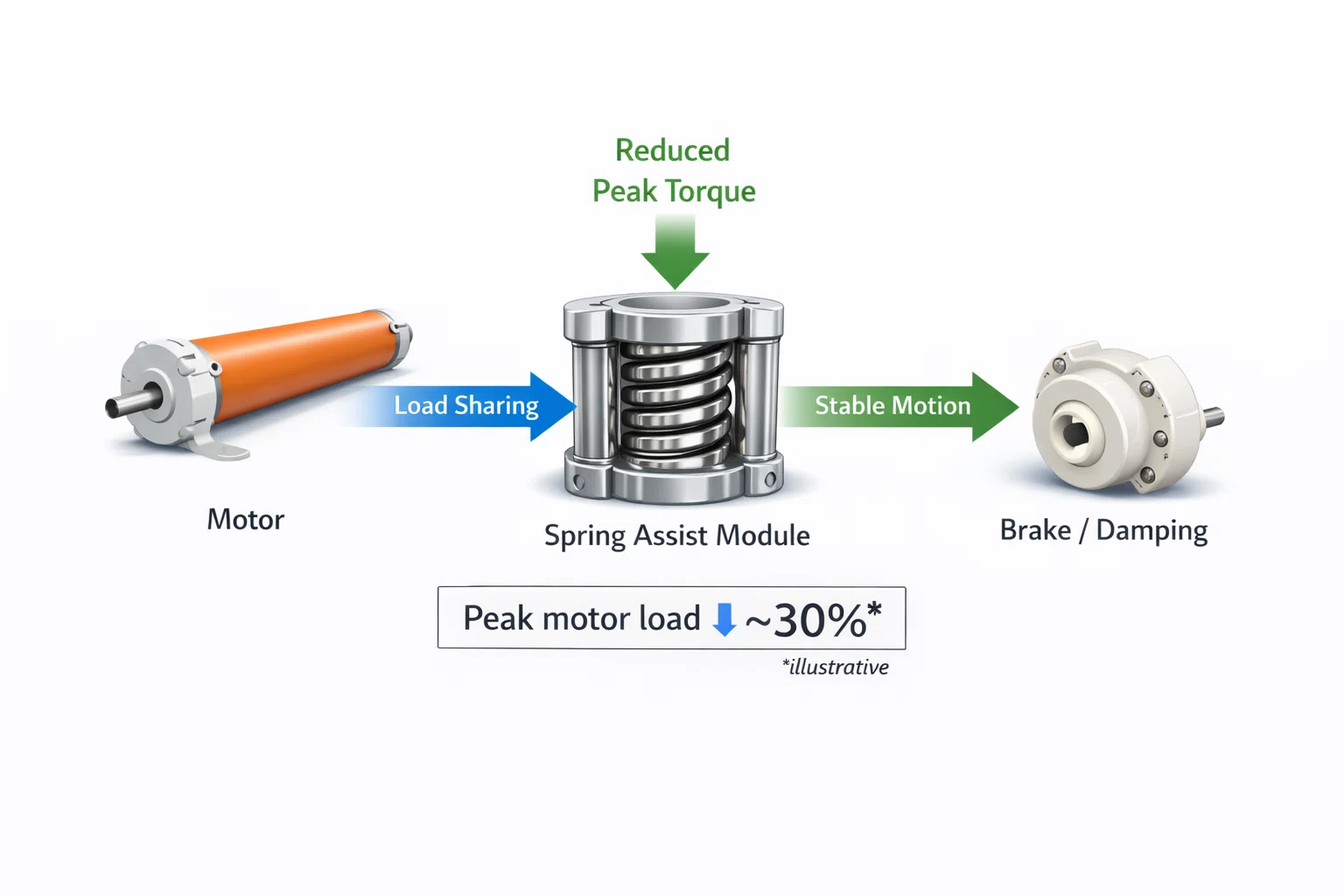
Spring-assisted motorization uses a spring module to offset a portion of gravitational load so the motor sees:
lower peak torque, less current draw, and more stable motion.
That can translate into longer battery intervals and less strain on drivetrain components—especially on larger shades.
Engineering Guidance (No Marketing, Just Control Logic)
- Design for peak load first: battery life collapses when the motor is forced into high-current peaks repeatedly.
- Stability beats speed: consistent rise speed reduces audible artifacts and perceived “strain.”
- Keep the brake honest: the brake must still control rebound and stop accuracy under assisted conditions.
Sustainability Angle: Recyclability and Project Specs
For commercial projects and green-building minded buyers, material choices increasingly matter.
Recyclability and documented material sourcing can support broader sustainability narratives and can align with LEED-related
materials & resources evaluation in certain project workflows.
Conclusion: 2026 Competition Is Precision Engineering, Not Low Price
In 2026, the US cordless market is not awarding points for being “cordless.”
The market rewards systems that stay quiet, stable, and consistent on large windows—and stay that way after aging.
The winners will standardize around:
variable/curve-shaped spring output,
quiet friction-controlled braking,
and verified lifecycle behavior.
If you are a US brand (or an OEM platform owner), the fastest path forward is to partner with suppliers who can deliver
the full engineering package: force-curve design, brake architecture,
material certification, and durability validation.
That’s how you define the next generation of window covering standards—without being trapped in price wars.
FAQ
1) What is the biggest 2026 engineering shift in cordless systems?
The shift is from “cordless compliance” to “lifecycle behavior control”:
consistent hand feel, quiet motion, large-size stability, and durability verification.
2) Why do oversized cordless shades fail more often?
Because the force-balance window is narrower. Small drift in spring force or friction can push the system into:
heavier pull force, mid-height creep, or top-end impact noise.
3) Are tapered/variable springs always necessary?
Not always. They are most valuable when the platform is pushed into wider/heavier specs where equal-geometry solutions
produce uneven feel across travel or become too sensitive to aging.
4) How do you reduce squeak and chatter without over-lubrication?
Use stable friction interfaces (materials + surface finish), geometry that suppresses micro-oscillation,
and defined preload control. Lubrication can help, but “lube-only” solutions often degrade over time.
5) What should a durability report include for US retailers?
At minimum: cycle-life results, force drift trends, noise trend notes, and material/corrosion evidence where applicable.
Bonus points for stress analysis and a clear acceptance band definition.
6) Does motorization eliminate the need for spring + brake engineering?
No. Motors still suffer under peak loads; spring assistance reduces load and improves stability, while braking still
controls stop accuracy, rebound, and perceived smoothness.
Field Insight: A 2026 Spec Checklist US Brands Can Actually Use
If you only do one thing this quarter, do this:
- Stop single-point pull testing. Require a force curve across travel (25/50/75/100%).
- Specify noise behavior near the top zone (where impact and chatter show up).
- Demand a spring+brake matched validation (not two separate component datasheets).
- Add an aging gate: cycle + humidity/heat exposure, then re-measure drift and feel.
- For oversized SKUs, evaluate variable/tapered geometry to widen the tuning window.