
Why Cordless Reliability Depends on Spring–Brake Synergy
 |
 |
Drift, sag, rebound, and noise are not random defects.
They are predictable outcomes of broken force-balance architecture.
Quick Summary
In cordless lift systems, long-term reliability is not determined by
spring quality or brake strength in isolation.
It is determined by how force generation (spring output)
and force control (braking authority) are engineered
as a single, aging-aware system.
Drift, sag, slam-up, and noise are not tolerance issues.
They are symptoms of broken force balance.
This article is part of our broader guide on maintenance-free cordless lift systems,
which examines system-level reliability, force control, and long-term field behavior across residential and commercial applications.
1. Why Traditional Springs Fail in Cordless Applications
Most traditional torsion springs and power springs were never designed
to hold position.They were designed to store energy.
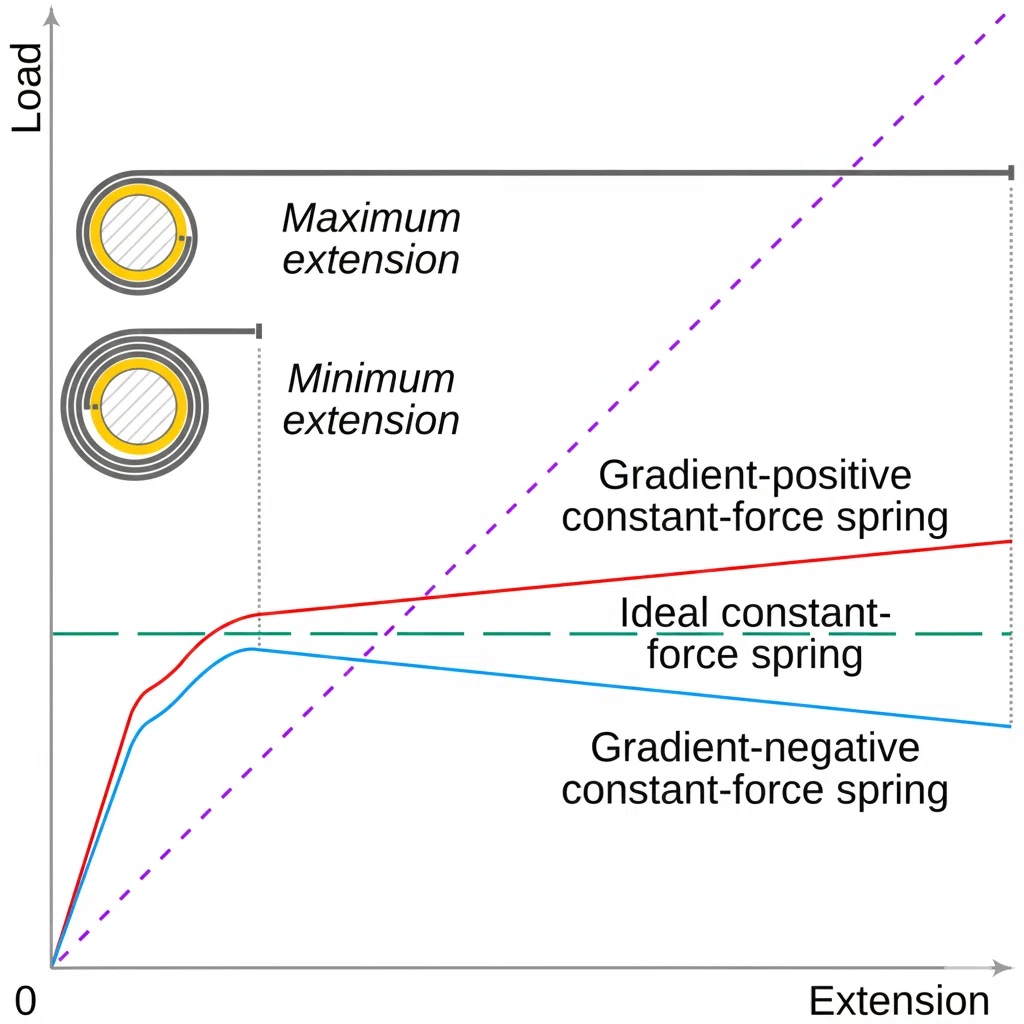
Their defining characteristic is simple and unavoidable:output torque varies with travel.
In a cordless lift system, this variable-force behavior produces repeatable, predictable failure modes:
- Over-lift at the top — excess stored energy releases too quickly when the shade is near full retraction.
- Mid-height instability — torque falls below the holding threshold, causing slow creep or sudden sag.
- Excessive pull force at full drop — torque peaks where user effort should be lowest.
None of these are manufacturing defects.They are mechanical consequences of applying a rising or falling torque curve to a system that requires near-constant force.
Cordless platforms require load-independent force behavior.
Traditional springs fundamentally cannot provide this without aggressive
and fragile compensation elsewhere in the system.
2. Constant-Force Springs: Stability Across the Entire Travel
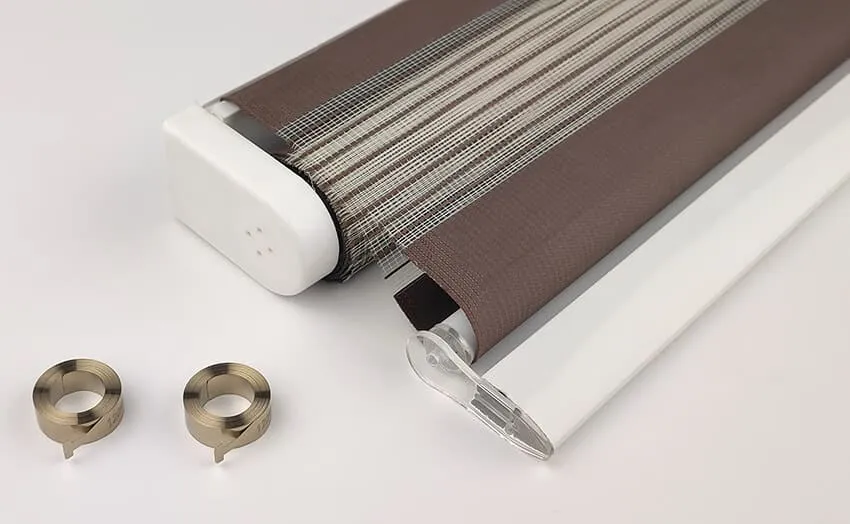
Constant-force springs exist to solve a very specific problem:
maintaining near-flat force output across the full stroke.
When correctly specified and installed, they enable:
- Position stability at any height, without relying on friction hacks.
- Predictable pull force from top to bottom.
- Reduced sensitivity to wear over tens of thousands of cycles.
This is why constant-force springs are not a “premium upgrade.”
They are a structural requirement for modern cordless platforms.
Without force stability at the source,every downstream component — brake, shaft, housing, bearings —is forced to compensate for a problem it cannot fully control.
3. The Friction Paradox: Smooth Feel vs. Secure Holding
Many cordless failures begin with a well-intentioned mistake:
chasing lighter pull feel by minimizing friction.
This approach produces a short-term showroom win and a long-term field failure.
A reliable cordless system must satisfy three conditions simultaneously:
- Low perceived effort during user input.
- High resistance to micro-movement under static load.
- Stable braking torque after wear-in and contamination.
These requirements are not contradictory —but they cannot be achieved through “low friction” alone.
The solution is controlled friction architecture:
- Defined contact interfaces.
- Stable preload mechanisms.
- Materials selected for predictable aging behavior.
Smooth motion is not the absence of friction. It is the presence of well-managed resistance.
| Field Failure Mode | Mechanical Root Cause | System-Level Design Fix |
|---|---|---|
| Mid-height drift / sag | Holding torque band too narrow | Constant-force spring + defined brake preload |
| Slam-up at top | Excess spring energy + weak damping | Brake authority matched to peak stored energy |
| Heavy pull at full drop | Rising torque curve | Flat force output across full travel |
| Noise after wear-in | Stick-slip friction growth | Controlled friction, not minimal friction |
| Early field failure | Spring and brake tuned independently | Spring–brake co-design with aging margin |
4. Aging Dynamics: Why Independent Tuning Always Fails
Springs lose output.
Friction interfaces change.
Lubricants migrate or disappear.
These are not edge cases.
They are guaranteed lifecycle events.
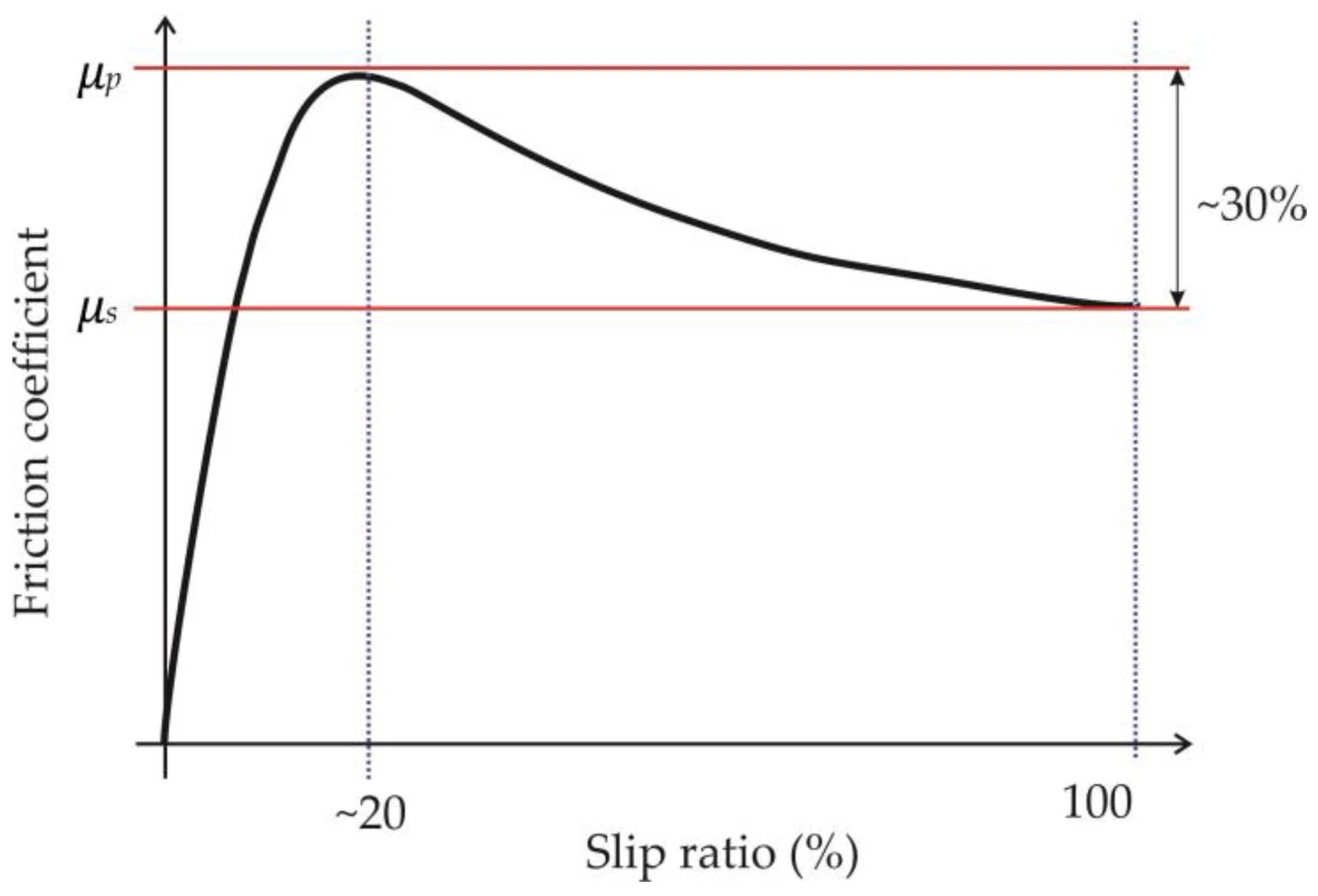
When springs and brakes are tuned independently,
their aging curves diverge.
- Spring force decays.
- Brake friction increases or becomes unstable.
- The original force balance collapses.
This is why many systems:“feel perfect out of the box”and fail six months later.
Only systems designed with aging margin —not just initial performance —remain stable over time.
Field Insight
Most cordless reliability issues do not come from bad parts.
They come from broken system architecture.
When force generation and force control are engineered as a single system,
drift disappears, rebound softens, and user perception improves —
not temporarily, but across the full product lifecycle.
In cordless design, synergy is not a feature.
It is the architecture.
FAQ: Spring–Brake Synergy in Cordless Systems
1. Why can’t a stronger brake fix a weak spring?
Because brakes control motion, not force balance.If spring output is insufficient at mid-height,increasing brake torque only increases pull effort and noise.
2. Can software or motor control compensate for poor mechanical balance?
Partially, and temporarily.Mechanical imbalance always resurfaces through noise,wear, energy consumption, or safety margin loss.
3. What is the ideal relationship between spring force and brake torque?
Spring force should slightly exceed system load (5–10% margin),while brake torque must cover peak stored energy with aging allowance.
4. Why do many systems pass lab tests but fail in the field?
Lab tests measure initial conditions. Field failures reveal aging, contamination, and wear interactions.
5. How does constant-force behavior reduce noise?
By eliminating rapid torque transitions that trigger stick-slip and impact events at end stops.
6. Is low friction always desirable?
No. Uncontrolled low friction reduces holding stability and accelerates wear-induced failure.
7. What causes mid-height drift months after installation?
Spring force decay combined with brake preload relaxation shrinks the holding torque band.
8. How important is preload consistency?
Critical. Preload variation directly translates into unit-to-unit performance scatter.
9. Can material upgrades alone solve reliability issues?
No. Material improvements without architectural balance only delay failure.
10. What defines a truly maintenance-free cordless system?
A system whose force balance remains stable despite wear, contamination, and time.