
Why Width Changes Everything in Cordless Engineering
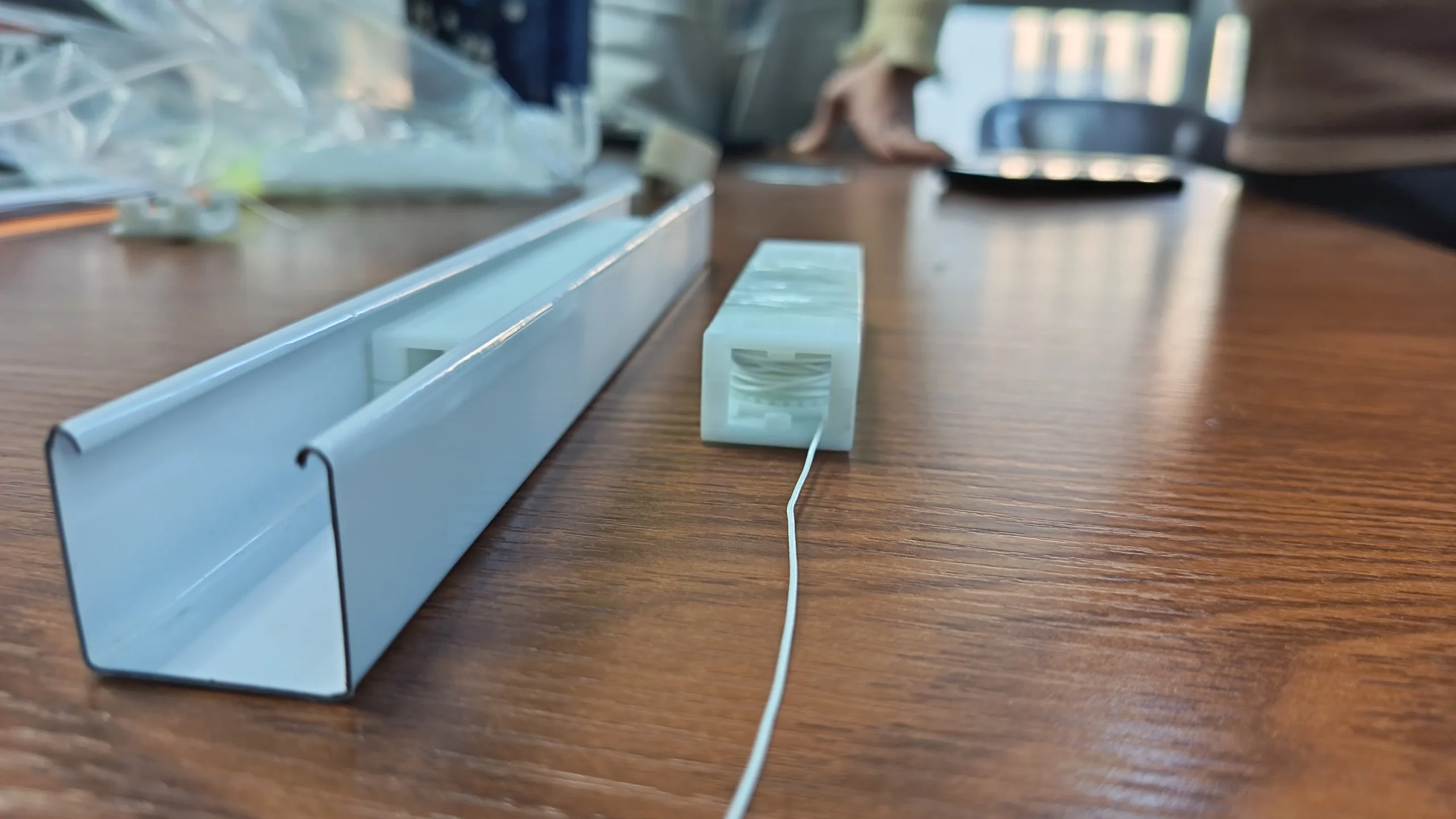
A wide cordless blind is not a bigger product.
It is a more sensitive mechanical platform.
Width does not create new problems—it magnifies the ones already there.
Quick Summary
In cordless blinds, increasing width fundamentally changes system behavior.
The bottom rail becomes a longer lever arm, left–right torque differences are amplified,
and small variations in spring output or friction turn into visible tilt, drift, and noise.
This is why wide sizes expose issues early—and why width should be treated
as a platform sensitivity multiplier, not a cosmetic dimension.
1) The Core Misunderstanding: “It’s Just More Fabric”
One of the most persistent assumptions in window coverings is that increasing width simply means adding more fabric. From a mechanical standpoint, this is incorrect.
In a cordless system, width changes the way forces are expressed and perceived.As the span grows, the bottom rail behaves less like a passive load and more like a lever-driven structural element.
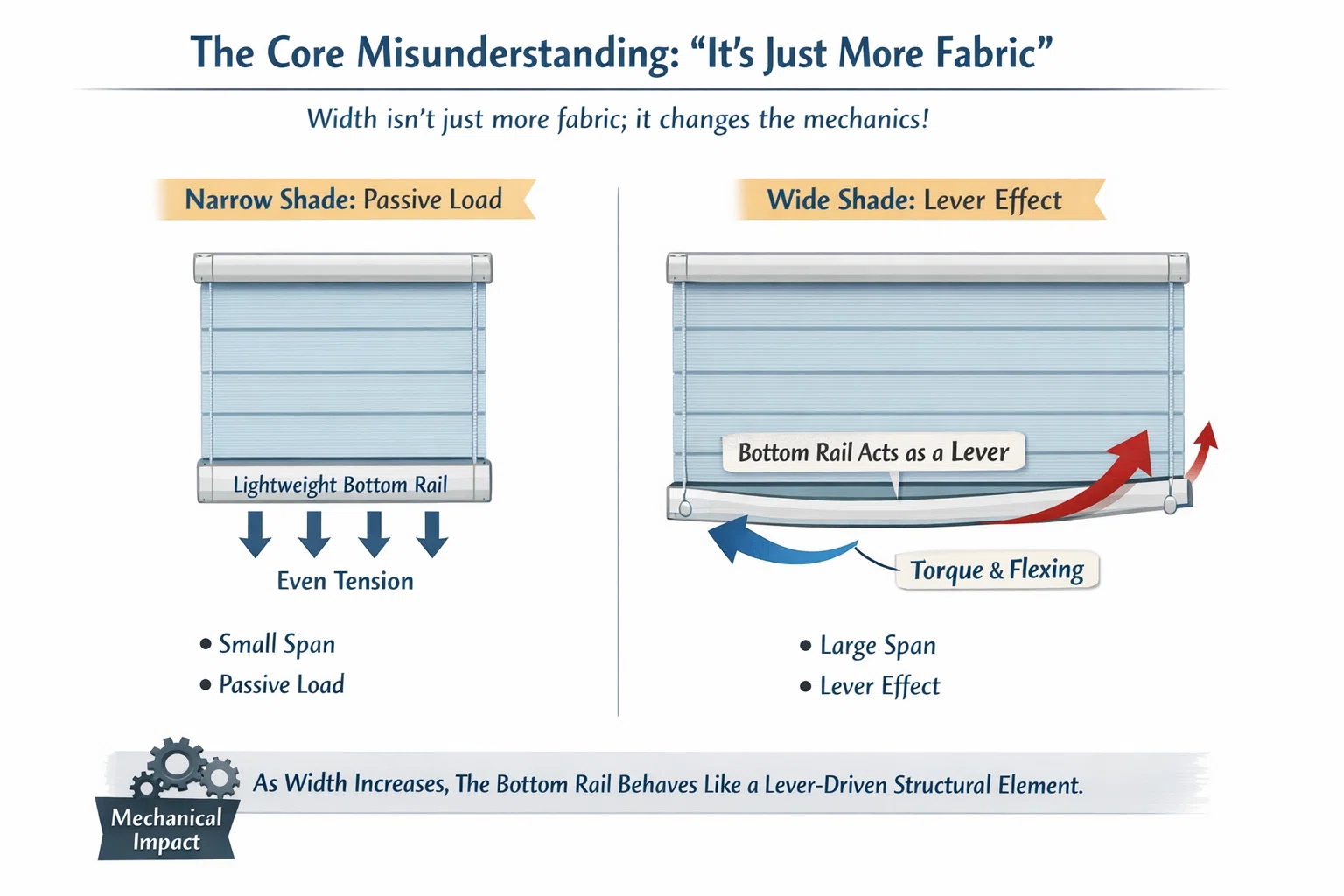
This is the point where a window covering quietly turns into a mechanical platform—
a transition explained at the system level in the
Cordless as a Mechanical System pillar.
Width does not add complexity linearly.
It increases sensitivity.
2) Width as a Force Amplifier
In narrow cordless blinds, small left–right differences often go unnoticed.
Structural stiffness, fabric compliance, and human tolerance mask minor imbalance.
As width increases, those buffers disappear.The bottom rail becomes a longer lever arm,
and angular deviation becomes easier to see.
2.1 Lever arm effect in simple terms
A small torque mismatch that produces negligible rotation on a 1.0 m blind
produces visible tilt on a 2.5 m blind.
The force did not change—the geometry did.
| Blind Width | Mechanical Sensitivity | Typical Field Outcome |
|---|---|---|
| ≤ 1.2 m | Low | Minor imbalance often unnoticed |
| 1.5–2.0 m | Moderate | Uneven lift under aging |
| ≥ 2.5 m | High | Visible tilt, noise, complaints |
This is why width thresholds matter.
Past a certain span, the system stops self-correcting.
It starts revealing imbalance.
3) Left–Right Symmetry Becomes a Design Constraint
In wide cordless blinds, the tube ends and bottom-rail ends
become force reference points.
Any asymmetry between left and right sides is amplified.
Sources of asymmetry include:
- spring output variation
- brake friction differences
- tolerance stacking in mounts and interfaces
- uneven wear paths over time
Installers can correct static alignment,
but they cannot correct dynamic imbalance that changes with travel.
That imbalance is baked into the force-balance system itself.
If a wide blind lifts evenly only after adjustment,
but drifts again after use,
the issue is dynamic—not installation-related.
4) Why Wide Blinds Fail Earlier in the Field
Wide blinds do not necessarily experience higher absolute loads.
What they experience is higher visibility of imbalance.
Aging accelerates this process.
As springs relax and friction interfaces evolve,
the force band narrows.
Width makes that narrowing obvious.
| Lifecycle Stage | What Changes | Why Width Makes It Worse |
|---|---|---|
| 0–3 months | Full spring output, low friction | Imbalance still masked |
| 6–12 months | Spring relaxation, wear-in | Tilt and drift become visible |
| 12–24 months | Force-band mismatch | Noise, complaints, returns |
This is why wide cordless blinds often generate
disproportionate warranty and service costs,
even when their narrow counterparts appear “fine.”
5) Why “Stronger Components” Is the Wrong Fix
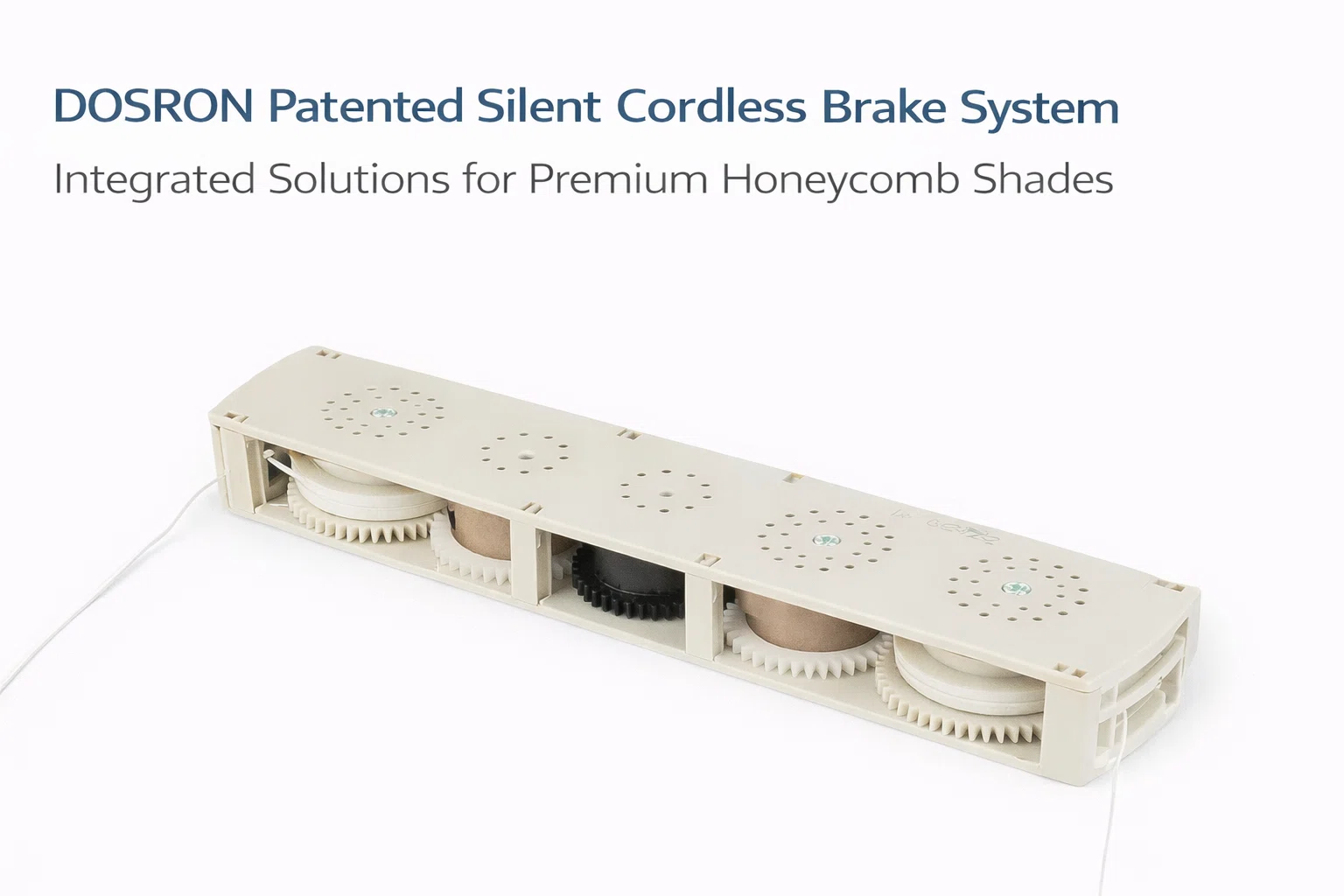
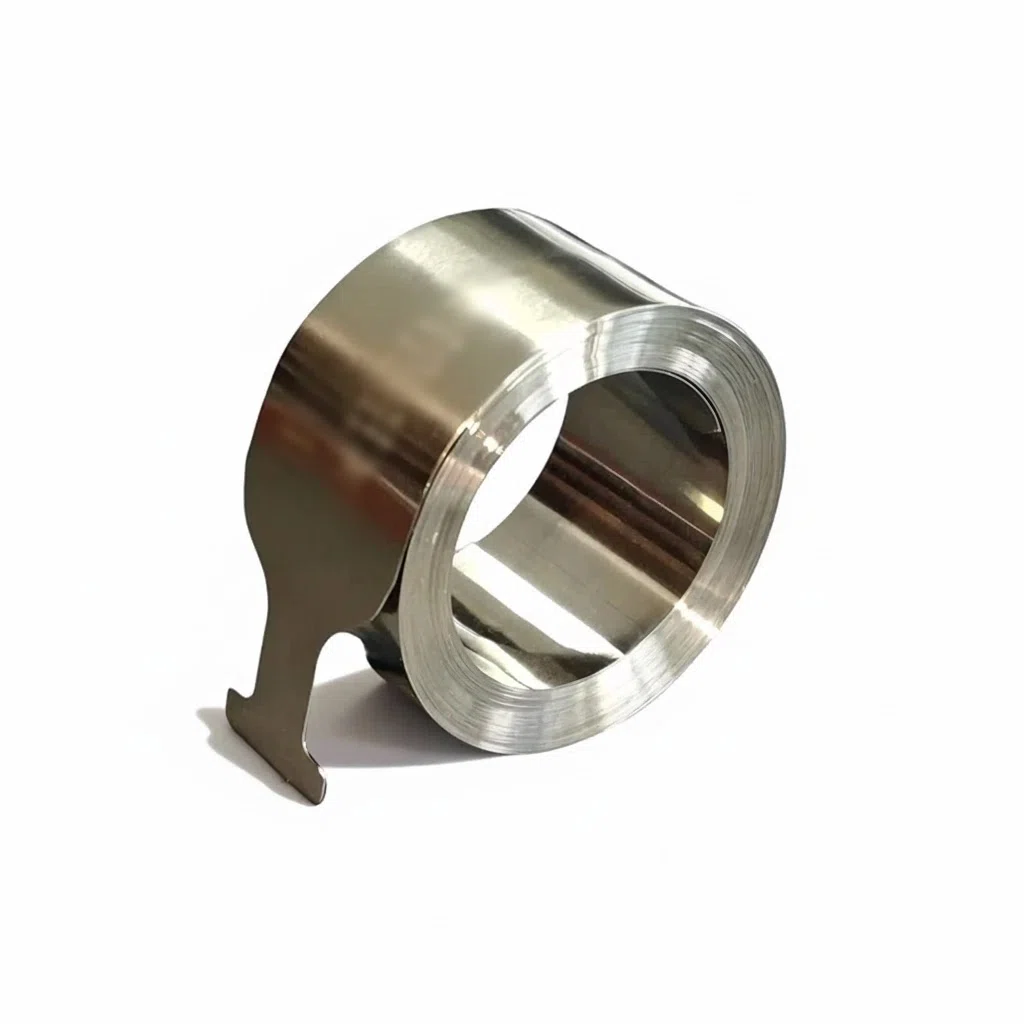
A common response to wide-size issues is to increase spring force or brake friction.
This can reduce visible symptoms temporarily,but it rarely improves long-term stability.
Stronger springs increase rebound risk.Higher friction increases pull force and stick-slip noise.
Neither approach addresses the underlying issue:
maintaining a stable force band across a sensitive platform.
 |
 |
This is why width must be treated as a system-level design input,not a post-launch adjustment problem—a principle central to the force-balance architecture discussed in the Pillar.
6) The Correct Engineering Question for Wide Cordless Designs
The right question is not:
“Can this system lift a wide blind?”
The correct question is:“Can this system maintain force balance,
left–right symmetry,and position stability across width, travel, and aging?”
When evaluated through this lens,wide cordless blinds stop being mysterious.
They become honest indicators of platform quality.
FAQ
Q1: Why do wide blinds show uneven lift first?
Width amplifies torque mismatch.Small left–right differences that are invisible in narrow blinds
become angular deviation in wide platforms.The bottom rail acts as a longer lever arm,
making imbalance easier to see and harder to ignore.
Q2: Is width or weight more critical in cordless systems?
Both matter, but they play different roles.
Weight stresses the system by increasing load,while width controls visibility by amplifying imbalance.A heavy but narrow blind may still appear stable,while a lighter but wider blind can reveal tilt and drift quickly.
Q3: Can tighter tolerances solve wide-size issues?
Tighter tolerances reduce unit-to-unit variation,but they cannot compensate for an unstable force band or mismatched aging behavior.If spring output and braking authority diverge over time,
even perfectly assembled units will develop imbalance.
Q4: Why do wide blinds often fail after months, not immediately?
Because imbalance is often latent.Early in the lifecycle, full spring output and low friction
can mask force-band weaknesses.As springs relax and friction paths evolve,width magnifies the resulting mismatch,making issues visible 6–18 months later.
Q5: Why does the bottom rail tilt instead of the entire blind moving evenly?
In wide systems, the bottom rail becomes a structural reference.When left and right sides experience different resistance or force,the rail rotates around its center of mass.
This angular response is the system’s way of revealing asymmetry.
Q6: Can installer adjustment permanently fix uneven lift?
Installer adjustments can correct static alignment,but they cannot fix dynamic imbalance.
If force balance changes across travel or with aging,the system will drift back out of alignment during use.
Q7: Why do some wide blinds feel smooth but still lift unevenly?
Smooth feel is primarily a friction characteristic.A system can feel smooth while still having
left–right force mismatch.Smoothness masks imbalance during motion,but it does not guarantee symmetric force distribution.
Q8: Does using stronger springs solve wide-blind instability?
Not reliably.Stronger springs increase upward force,but they also raise rebound risk and sensitivity to braking mismatch.Without a stable force band,stronger components often shift the problem rather than solve it.
Q9: Why are wide cordless blinds more sensitive to aging than narrow ones?
Aging changes spring output and friction behavior.
In narrow blinds, these changes may stay below the visibility threshold.
In wide blinds, the same changes are amplified by geometry,making aging effects visible sooner.
Q10: What is the correct way to evaluate a wide cordless platform?
Do not ask whether it can lift a wide blind once.Ask whether it can maintain
force balance, left–right symmetry, and position stability across width, full travel, production variation, and aging.Wide blinds are not edge cases—they are truth tests.
Field Insight
Wide cordless blinds do not fail because they are wide.They fail because width removes the system’s ability to hide imbalance.When a platform is well balanced,width is uneventful.When it is not,
width tells the truth—quickly and visibly.