
Why Does a Cordless Shade Drift or Jump? Spring Torque Tuning for Smooth, Stable Lift
 |
|
Cordless should not “walk itself.” If your shade slowly slips after you stop it (drift), or pops upward the moment you let go (jump), it’s rarely “bad luck.” Most of the time it’s a mismatch between the spring torque curve and the load curve.
Quick Summary
Drift: after stopping at any height, the shade moves >10 mm within 30 seconds (down or up).
Jump: at release, the shade suddenly pops upward >50 mm, then rebounds (often with a short “click/thump”).
Practical tuning targets (common engineering acceptance windows): spring output ≈ load × (1.05–1.10); pull-down operating force ≤30 N; lift speed 0.10–0.20 m/s; noise ≤35 dB; assembly coaxiality ≤0.10 mm.
If you only remember one line: across the full travel, keep the system in “slightly supportive torque + controlled damping.” Drift and jump usually disappear together (yes—like installing emotional stability inside the headrail).
1) Drift vs. Jump: Two Different Failure Modes
| Symptom | Quantified Signal | Most Common Root Cause | First Move |
|---|---|---|---|
| Drift Down | At any height, slips >10 mm in 30 s; often worse near the top | Insufficient torque or excessive damping; near-top radius is smaller so torque margin is tighter | Reduce damping/brake torque or increase spring torque (start with preload) |
| Drift Up | At rest, rises >10 mm in 30 s; often worse near the bottom | Excess torque plus insufficient damping; at larger radius the “extra torque” lifts the shade | Increase damping/brake torque or reduce spring torque (start by lowering preload) |
| Jump / Bounce | On release, pops up >50 mm, then rebounds; may include brief “click” or squeak | Stiction (static vs. dynamic friction gap), backlash take-up, or too-narrow damping band | Check friction materials/finish, assembly clearance, and brake consistency (don’t immediately “crank preload”) |
2) Why the Same Spring Behaves Differently at Different Heights: Radius Changes, Required Torque Changes
For roller-style cordless shades, the “load” is not constant. As the fabric wraps on the tube, the effective wrap radius reff changes across travel:
near the top (almost fully raised), reff approaches the bare tube radius; near the bottom (fully lowered), reff is larger (tube + multiple fabric layers).
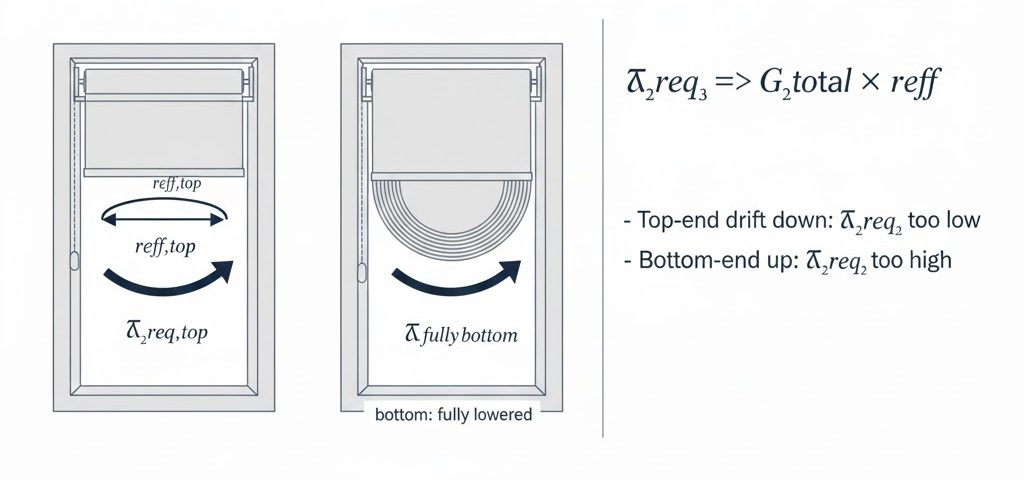
A very useful approximation is: required holding torque τreq ≈ Gtotal × reff.
If reff shifts from 20 mm to 35 mm, τreq increases to about 1.75×.
That’s why top-end drift down often points to “torque too low / damping too high,” while bottom-end drift up often points to “torque too high / damping too low.”
Bottom line: to be stable across the full travel, you don’t need “a stronger spring.”
You need a better-matched torque curve plus a controllable damping bandwidth.
3) A 5-Minute Quantified Diagnosis: The 3-Point Method (10% / 50% / 90% Travel)
Use a consistent test routine to convert “feel” into data. Record three sets of numbers:
- Rest drift: at 10% / 50% / 90% positions, let it sit for 30 seconds, record displacement (mm).
- Pull-down operating force: measure with a force gauge; target ≤30 N (above that, users will complain it “feels like a workout”).
- Lift time / speed: time bottom-to-top; common target 8–15 seconds (about 0.10–0.20 m/s).
| Position | Drift in 30 s | Typical Interpretation | Priority “Knob” |
|---|---|---|---|
| 10% (near top) | Downward >10 mm | Insufficient top-end torque margin / damping too high | Reduce damping or +0.5 to +1 turn preload |
| 50% (mid-height) | Intermittent bounce/jump | Stiction + backlash take-up | Friction material/finish + clearance & coaxiality |
| 90% (near bottom) | Upward >10 mm | Excess bottom-end torque / damping too low | Increase brake torque or -0.5 to -1 turn preload |
4) Spring Torque Tuning: Four “Knobs” (Don’t Keep Turning Only One)
Knob A: Preload — Fastest, Cheapest, and Easiest to Overdo
- Common starting point: 3–5 turns of installation preload (depends on architecture and load band).
- Recommended step size: change only 0.5–1 turn per iteration, then re-run the 3-point method.
- Red flags: after adding preload, if pull-down force jumps to >50 N or jump/bounce worsens—you’re using brute force to hide a curve mismatch.
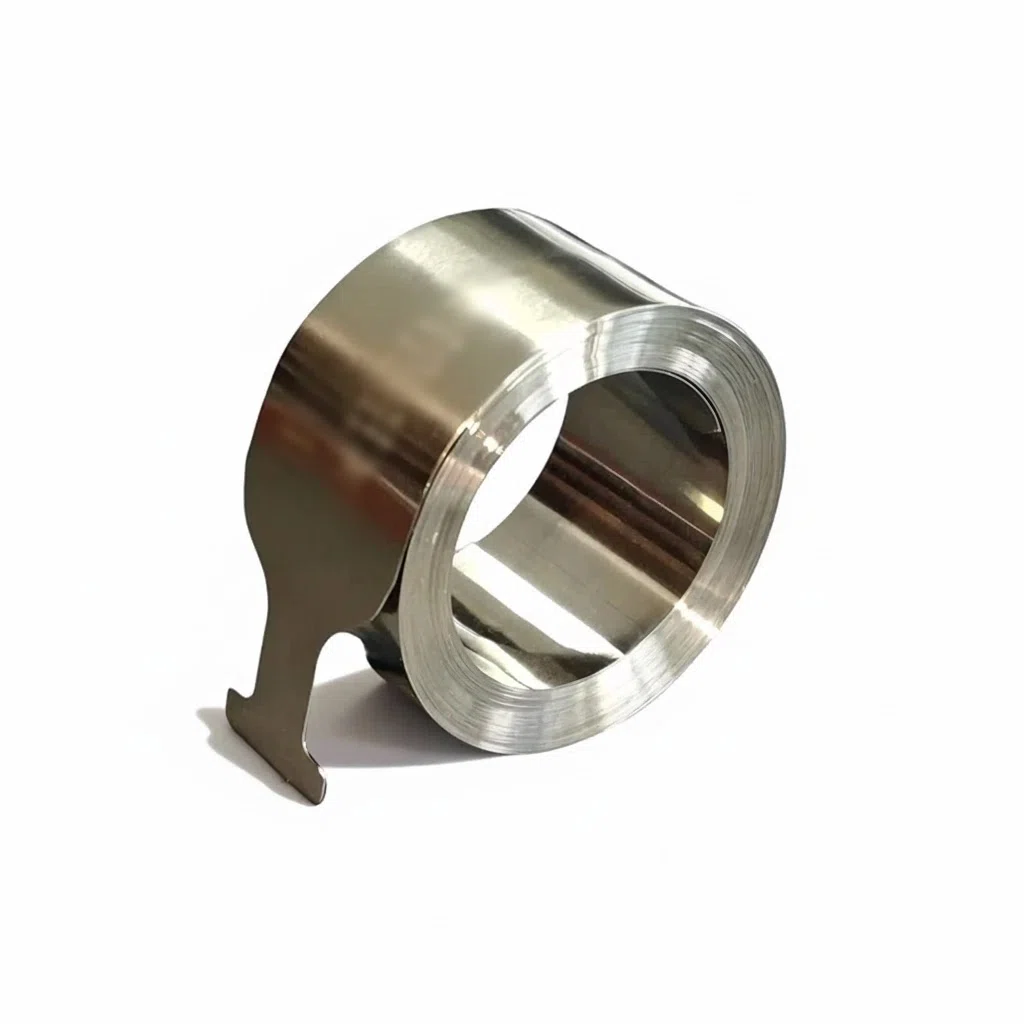
Knob B: Spring Spec (strip thickness/width/effective wraps) — Sets the Shape of the Torque Curve
Constant-force and spiral torsion springs have a “brutal but honest” reality:
thickness influence is often close to cubic (t³) in simplified scaling.
Example: changing strip thickness from 0.30 mm → 0.40 mm can theoretically shift output toward ~2.37× ((0.4/0.3)³).
Translation: don’t gamble your after-sales on a 0.1 mm thickness jump.
Knob C: Damping / Brake Banding — The Best Fix for “Jump” and “Top Slam”
- If your main issue is jump (that release “pop”), first check: is static friction peak too high, and is brake consistency too scattered?
- Practical target: stabilize lift speed at 0.10–0.20 m/s while preventing hard top impact.
- Plain truth: too little damping is “free spirit,” too much damping is “emotional suppression”—both become problems, just with different symptoms.
Knob D: Coaxiality & Clearance — Many Jumps Are Actually Assembly “Coughs”
- Recommended control: coaxiality ≤0.10 mm. If >0.20 mm, expect higher wear, more noise, and amplified force ripple.
- Backlash can create a “free run → re-engage” event at release, a classic trigger for jump.
- If mid-height behavior is “sometimes fine, sometimes not,” don’t blame the spring first—check batch-level variation in end plugs / supports / bearing pockets.
5) Stronger OEM Differentiation: Put the Tuning Window Into Your Spec Sheet
Many cordless shades only claim “smooth” and “quiet.” You can be more engineering-driven—and more verifiable.
That is differentiation: translate “feel” into measurable acceptance criteria.
| Metric | Recommended Window | User Perception | Typical Complaint If Out of Spec |
|---|---|---|---|
| Torque Match | 1.05–1.10× load | Holds position, moves predictably | Drift / won’t stay mid-height |
| Pull-down Force | ≤30 N | Easy, light pull | “Too heavy” / “kids can’t use it” |
| Lift Speed | 0.10–0.20 m/s (or 8–15 s full travel) | Controlled, premium feel | Top slam / rebound / sluggish rise |
| Noise | ≤35 dB | “Barely audible” | Squeak / click / grinding |
| Assembly Coaxiality | ≤0.10 mm | Consistent hand-feel, stable life | Intermittent jump, batch variation |

FAQ: 8 Questions Engineering Teams Ask Most
Q1: Why does jump happen most often at mid-height?
A: Mid-height is where friction state transitions are most frequent: static → dynamic → static again. Combined with backlash take-up, release events are more likely to “pop.”
Q2: Can I fix drift by simply increasing preload?
A: Sometimes it looks better short-term, but it often turns into heavy pull-down or more obvious jump. Drift is fundamentally a curve match problem; preload is only one knob.
Q3: What if I see top drift-down and bottom drift-up at the same time?
A: That’s a classic sign the torque curve shape is wrong (not just a single-point offset). Set damping bandwidth first (stabilize speed), then revisit spring spec (strip / wraps / architecture) to correct the curve.
Q4: What level counts as “dangerous torque excess”?
A: A practical engineering line is: when output exceeds load by ~15%, risk rises for heavier pull-down, top slam, and jump/bounce events.
Q5: Is a small coaxiality error really that sensitive?
A: Yes. It converts the system into eccentric wear + periodic friction ripple. You feel drift/jump; you don’t immediately see the hidden costs: life reduction and batch scatter.
Q6: How do I quickly tell if it’s damping vs. spring?
A: If symptoms are mainly speed instability / rebound, prioritize damping and friction materials. If symptoms are mainly won’t hold (continuous drift), prioritize torque match and preload.
Q7: Are there recommended target windows for speed and operating force?
A: Common targets: lift 0.10–0.20 m/s (or 8–15 s full travel), pull-down ≤30 N. In retail and premium projects, these two metrics strongly define “premium feel.”
Q8: Why does a Cordless system require full-travel tuning more than corded?
A: Because the user interacts directly with the bottom rail—any force ripple becomes obvious “hand-feel.” With no external cords/loops, the root causes concentrate inside: spring curve + damping bandwidth + tolerance stack-up.
Field Insight
In mass production, drift/jump is rarely a single-part problem. It’s usually the overlap of
torque curve (spring), damping bandwidth (brake/damper), and coaxiality/clearance (assembly stack-up).
When you write acceptance as quantified windows (e.g., ≤30 N, ≤35 dB, 0.10–0.20 m/s, coaxiality ≤0.10 mm),
your after-sales becomes dramatically quieter—and your product feels more “premium,” because it is stable.