
The Future of Cordless Window Coverings: Safety, Compliance, and the U.S. Market Shift
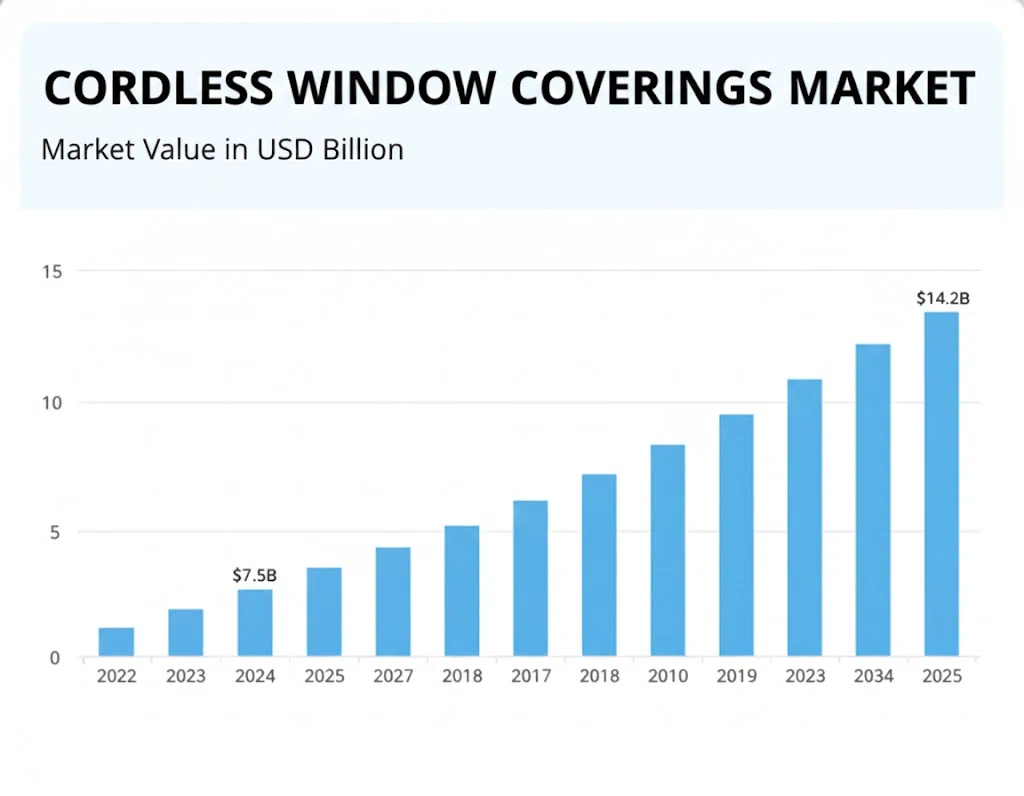
In the U.S., cordless window coverings are no longer a “nice-to-have” design choice. They’re the result of safety expectations,
compliance pressure, and retailer-driven risk control. This pillar guide explains what is changing, what “cordless” really means in
engineering terms, and how brands and OEMs can prepare without triggering new reliability or user-experience failures.
Quick Summary
- Cordless is becoming the default in the U.S. because safety + compliance + retailer requirements are converging.
- The real transition is not “cord vs. no cord,” but cord-lock platforms → force-managed lift systems.
- “Cordless” can still include internal lift cords; safety depends on architecture, not marketing labels.
- Engineering priorities shift to force curve matching, braking/damping, alignment control, and durability.
- For brands/OEMs, the big risk is not only non-compliance—it’s field failures (drift, slam-to-top, noise, high pull force).
1) Why the U.S. Market Is Forcing the Cordless Transition
The cordless shift in the U.S. is driven by a simple reality: traditional corded window coverings introduce avoidable hazards
(especially for children) and create disproportionate liability for brands, importers, and retailers. Once a category is perceived as
“preventable risk,” the market moves quickly—often faster than product development cycles.
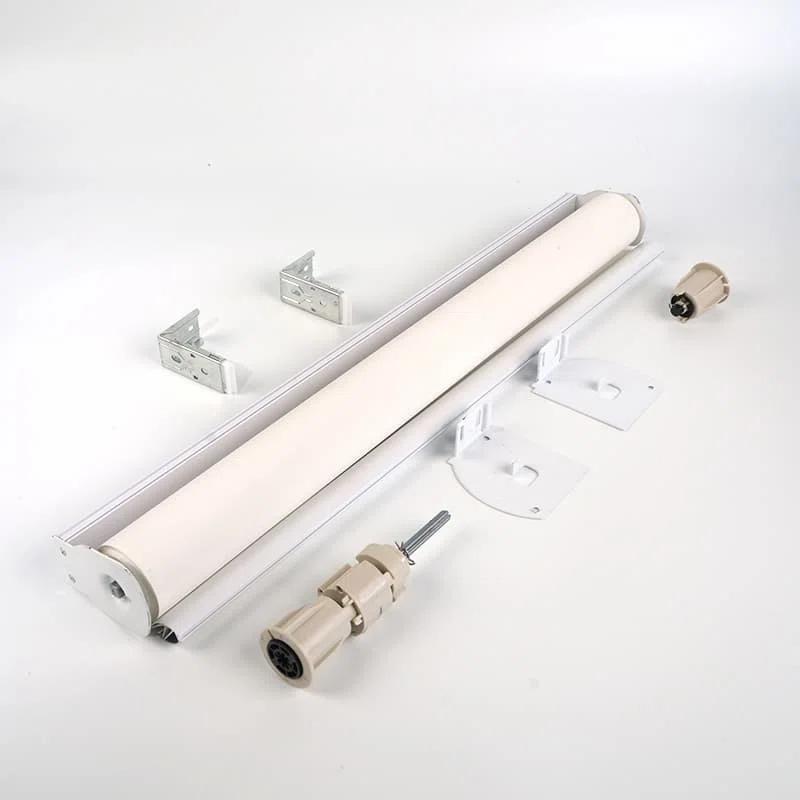
In practice, the U.S. transition is pushed by three aligned forces:
- Safety expectations: Consumers and institutions increasingly treat exposed cords as unacceptable in residential and many commercial environments.
- Compliance pressure: Requirements evolve, and enforcement can shift from “recommended” to “expected” for major channels.
- Retailer risk control: Large retailers and platforms often implement stricter internal standards than the minimum legal baseline to reduce recalls and claims.
 |
|
This is why “still selling corded SKUs” is not the same as “future-proof.” A platform can remain available in niche channels, while
mainstream U.S. distribution steadily collapses toward cordless architectures.
2) Understanding the Regulatory Drivers (ANSI/WCMA, CPSC)
If you manufacture or source for the U.S., the main challenge is not memorizing acronyms—it’s understanding the direction of travel:
standards and enforcement increasingly reward architectures that remove hazardous accessible cords and reduce foreseeable misuse.
2.1 Standards vs. enforcement: why both matter
- Standards (e.g., ANSI/WCMA) establish test methods and performance expectations that shape product design and retailer acceptance.
- Regulators (e.g., CPSC) may set mandatory rules and drive enforcement actions; this affects recalls, import risk, and legal exposure.
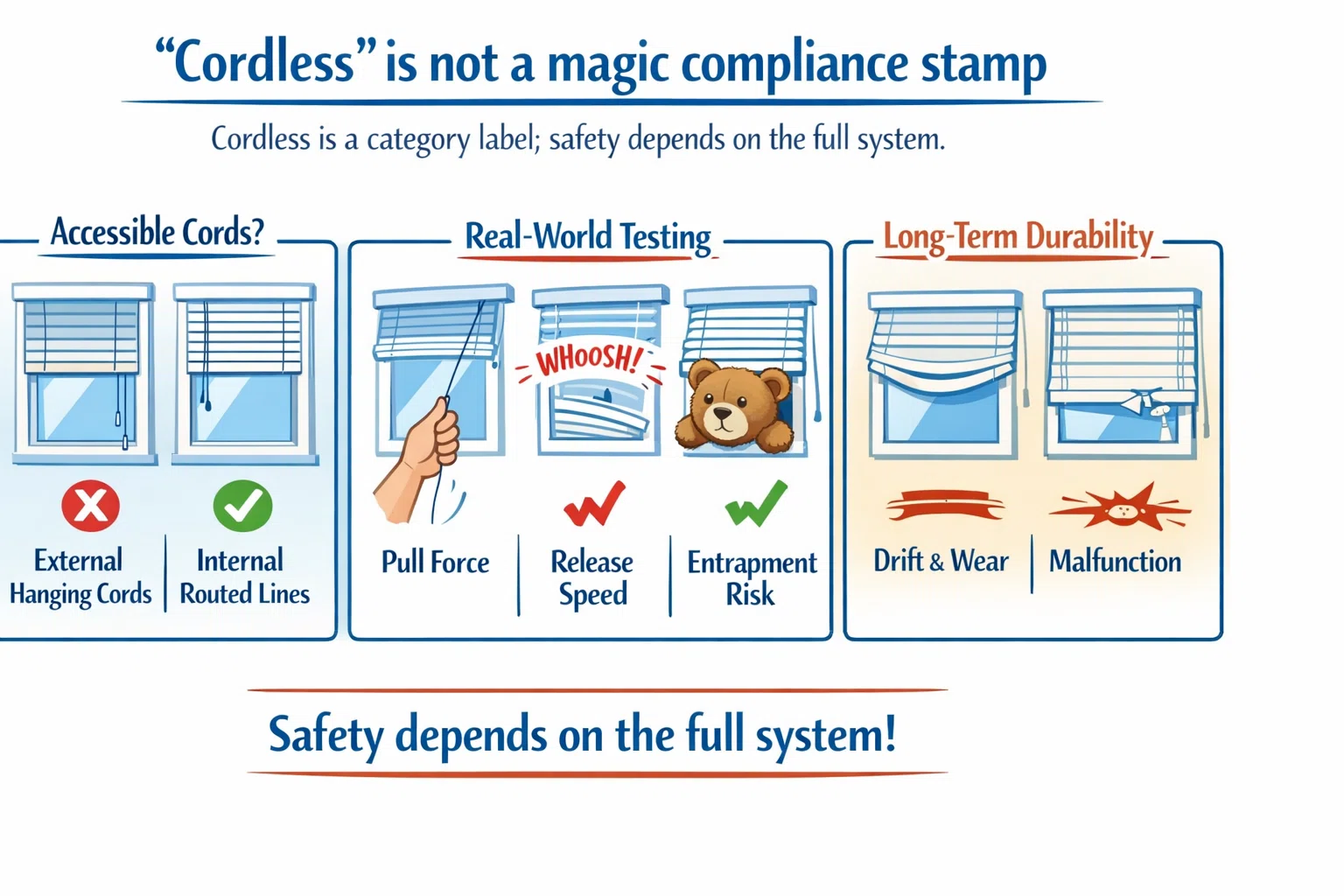
2.2 “Cordless” is not a magic compliance stamp
A common misconception is that “cordless” automatically means “safe” or “compliant.” In reality, cordless is a category label; the
safety outcome depends on the full system:
- Whether any cords remain accessible (external hanging cords vs. internal routed lines)
- How the system behaves under real use (pull force, release speed, rebound, entrapment scenarios)
- Durability and drift over time (wear can reintroduce hazards and failures)
Practical takeaway: treat “cordless compliance” as a design verification problem, not a naming problem.
3) Cordless Does Not Mean Simple: The Hidden System Shift
Many legacy products relied on cord-locks and user-controlled cords to manage load, speed, and position holding. When you remove the
external cord interface, those functions must be delivered by an internal drive stack—inside a tight mechanical chassis (headrail/tube).
3.1 What replaces cord-lock behavior
A modern cordless lift system typically includes:
- Energy source: spring module, constant-force spring, torsion spring, or a motorized drive
- Speed control: brake/damper to prevent slam-to-top and stabilize rise rate
- Transmission: shaft/drum/reel converting torque into controlled lift motion
- Support interfaces: bearings, end plugs, brackets; small misalignments become large friction
- Load side: tube + fabric + bottom rail; squareness and mass distribution determine tracking
3.2 The “cordless failure modes” that show up in the field
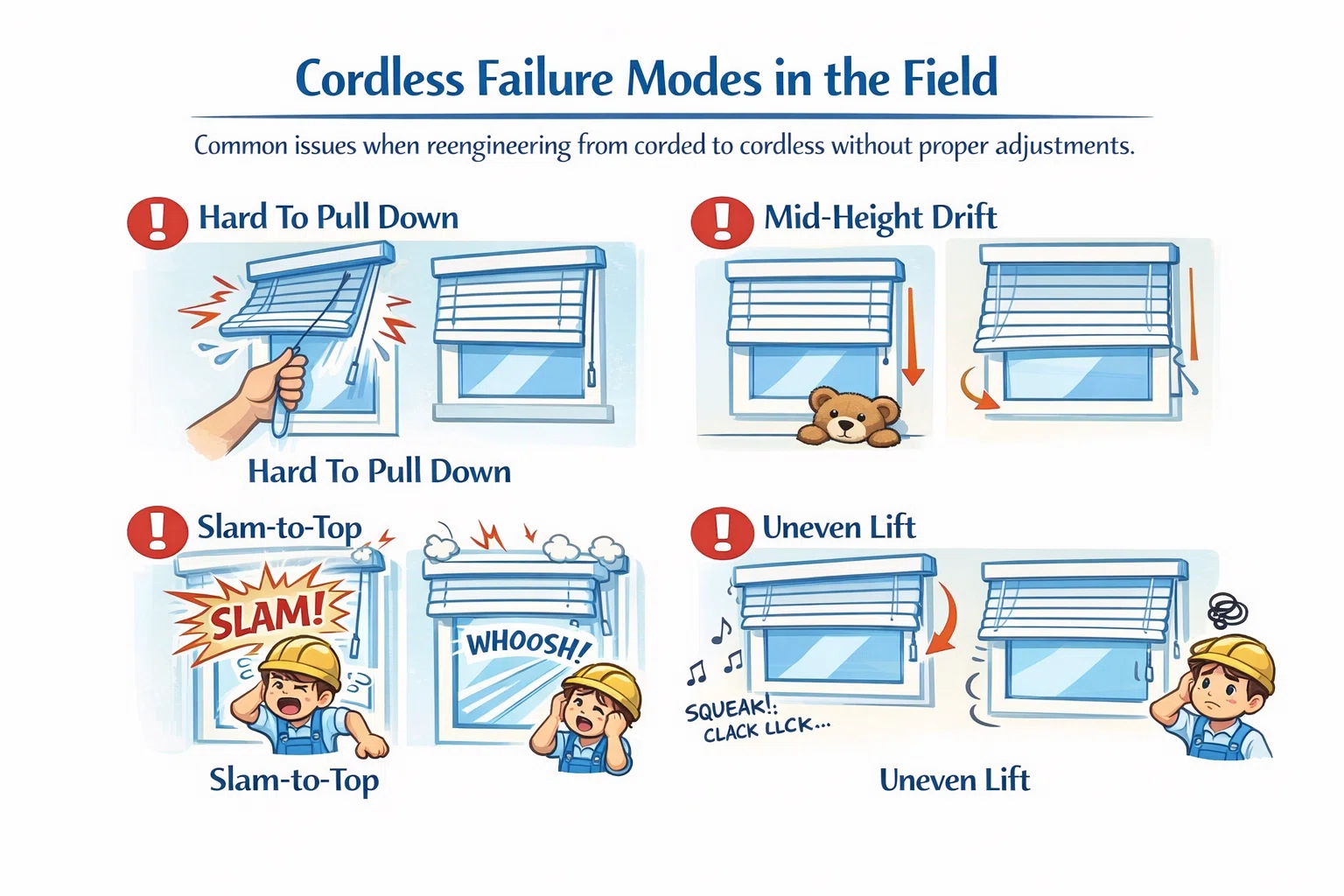
When an OEM migrates from corded to cordless without re-architecting the system, issues tend to concentrate into repeatable failure modes:
- Excessive pull-down force: spring output too high, poor force curve matching, or high internal friction
- Mid-height drift: insufficient holding torque band, brake under-tuned, or friction instability
- Slam-to-top / top impact: weak damping, torque overshoot, or inconsistent brake behavior after wear-in
- Noise complaints: chatter from tolerances/runout, squeak from stick-slip friction pairs, knock from end-stop impact
- Uneven lift: coaxiality errors, tolerance stack-up, or asymmetric load distribution
The pattern is consistent: cordless shifts the complexity inside. If you don’t engineer the internal stack as a system,
the product will “pass the sample test” and then fail at scale.
4) Safety Is a System Outcome, Not a Single Feature
In the U.S. market, safety is evaluated by what users can access, what the product does under normal use and foreseeable misuse, and
how it behaves after aging. That means “no external cords” is necessary but often not sufficient.
4.1 Force control is safety control
Pull-down force that is too high drives unsafe user behaviors (yanking, side-pulling, grabbing non-structural parts). Pull-down force that
is too low can make position holding unreliable. The target is a stable, repeatable force band across travel—matched to the
real load, not just the nominal fabric weight.
4.2 Speed control reduces impact, noise, and stress
Damping/braking is not “comfort-only.” It prevents top impact events that can damage components, create noise spikes, and shorten life.
In other words: speed control reduces lifecycle safety risk.
4.3 Durability is part of compliance reality
A product that behaves safely on day one but drifts, squeaks, or slams after a few thousand cycles becomes a warranty and brand risk.
For U.S. channels, durability is not just a quality metric—it’s the long tail of safety and claims exposure.
5) What This Shift Means for Brands, OEMs, and Importers
The cordless transition changes responsibility boundaries. Brands and importers are increasingly expected to demonstrate that they
understand their product architecture—not just that they bought a “cordless” part.
5.1 The hidden cost of “legacy platform reuse”
Reusing a corded headrail profile and simply “dropping in” a spring module can work for a prototype, but scale exposes the weak links:
tolerance stack-up, friction sensitivity, and batch-to-batch drift. The result is often a wave of inconsistent hand-feel and rising behavior.
5.2 A practical readiness checklist for U.S.-bound cordless programs
- Define acceptance limits: pull force at multiple travel points, rise time, mid-height drift, noise threshold
- Verify batch repeatability: “1 unit = 10,000 units” consistency with process control, not hope
- Map failure modes: drift / slam / squeak / uneven lift, and assign root-cause tests
- Document architecture: what is accessible to the user; where cords exist (if any); how hazards are prevented
- Lifecycle tests: cycle testing + wear-in rechecks (brake stability, force curve stability, fastener loosening)
6) Preparing for the Next Phase of the U.S. Market
The next phase of the U.S. cordless market is not simply “more cordless.” It’s a move toward systems that are:
maintenance-friendly, repeatable in mass production, quiet in real homes, and stable over long lifecycle use.
6.1 From “cordless” to “maintenance-aware”
As cordless becomes the baseline, differentiation shifts to long-term stability: fewer callbacks, fewer pull-force complaints, fewer
noise tickets. This is where controlled friction interfaces, robust alignment features, and well-defined tuning processes win.
6.2 Quiet operation is becoming a premium signal
In high-end residential and hospitality projects, “quiet” is not decoration. It’s perceived build quality. Noise tends to be a symptom:
stick-slip friction, micro-oscillation, runout, or top impact. Solve the root cause, and you improve both safety and perceived quality.
6.3 What to standardize now (so you don’t suffer later)
- System tuning workflow: preload / torque banding / damping targets with measurable acceptance criteria
- Interface control: coaxiality, bearing seats, bracket alignment, and controlled tolerance stack-up
- Material pairs: stable friction coefficients over humidity/temperature, low squeak risk
- Verification cadence: re-test after wear-in cycles; validate not just “works,” but “stays working”
FAQ
Q1: Does “cordless” always mean there are no cords anywhere in the product?
Not necessarily. Many cordless architectures remove external hanging cords but may still use internal routed lift lines or tapes.
Safety depends on whether hazardous cords are accessible and how the system behaves under foreseeable use.
Q2: What is the most common engineering mistake when converting a corded platform to cordless?
Treating cordless as a part swap instead of a system redesign. The internal drive stack must manage force, speed, and holding stability.
If friction, alignment, and damping are not engineered together, field failures spike.
Q3: Why do some cordless shades feel “heavy” to pull down?
Usually because the spring output is oversized, the force curve is mismatched to the real load, or internal friction is high due to
tolerance stack-up or poor interface design. Pull force should be evaluated across travel, not at one point.
Q4: What causes “slam-to-top” behavior after a few weeks of use?
Brake/damping instability after wear-in, friction coefficient change, or torque overshoot relative to the load as the system beds in.
This is why post-wear verification is critical.
Q5: How should OEMs prove readiness for U.S. cordless programs?
Use measurable acceptance limits (pull force, rise time, drift, noise), validate batch repeatability, and document the architecture.
The goal is a controlled process, not a lucky sample.
Field Insight
In the U.S. market, cordless is no longer about differentiation—it’s about survival. The brands that win are not those who remove cords
fastest, but those who redesign their lift systems with predictable force, controlled motion, and
long-term stability in mind. If your engineering team treats cordless as “just a compliance label,” your support team will pay the price later—one drift complaint at a time.
Related guides:
Maintenance-free cordless lift systems for commercial projects
How to calculate spring tension for cordless window blinds