
Cordless ≠ Simple: Hidden Mechanics Behind Lift & Hold
 |
|
Removing the cord does not remove complexity.
It transfers responsibility—from the user to the system itself.
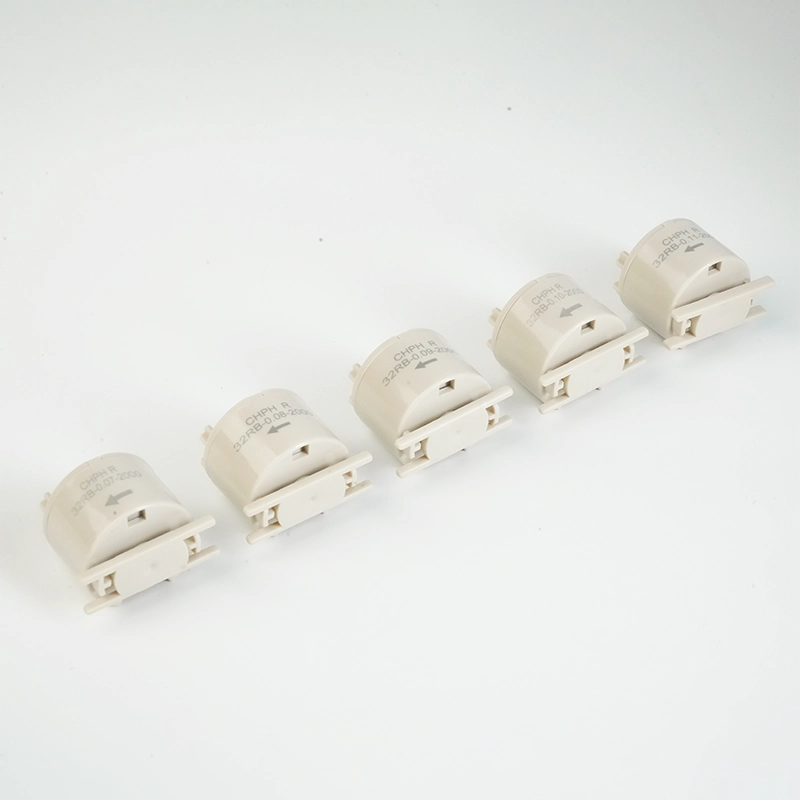
In cordless blinds, holding position is harder than lifting.
Quick Summary
Cordless blinds are often perceived as simpler because cords are removed.
Mechanically, the opposite is true.
A cordless system must continuously manage energy, gravity, and braking
without user input.
While lifting motion can be tuned to feel light and smooth,
holding position across full travel and over time
requires a stable force-balance system.
Most real-world failures occur not during lift,
but when the system can no longer hold reliably.
1) Why Cordless Feels Simpler — But Isn’t
From a user’s perspective, cordless blinds feel intuitive:
push up, pull down, no cords to manage.
This simplicity at the interface often leads to a false conclusion—that the internal mechanism must also be simpler.
In corded systems, the user supplies energy and correction.Subtle imbalance, friction variation, or asymmetry is unconsciously compensated for by human input.
In cordless systems, that correction loop is gone.The system must regulate itself at all times.
At that moment, the product stops behaving like a manual covering and becomes a self-governing mechanical platform, as explained in the
force-balance system overview.
Cordless removes user assistance.
All balance, correction, and stability must come from the mechanism itself.
2) Lift Is a Motion Problem — Hold Is a Stability Problem
Most marketing and testing focuses on lift effort:
how light the blind feels when moving up or down.Lift is a transient event.
Hold is a continuous requirement.
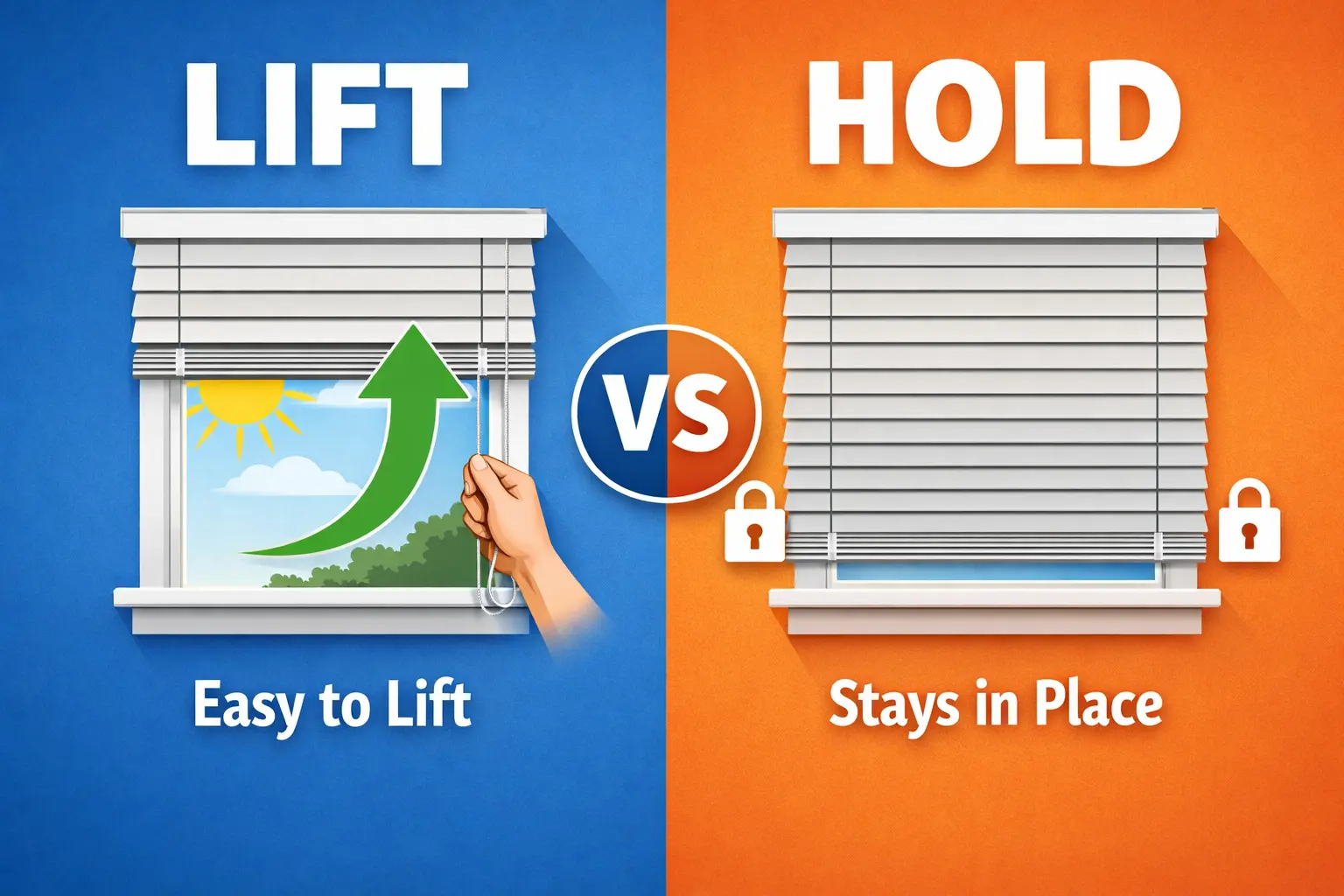
Holding position means the system must resist micro-movements caused by:
- spring force variation across travel
- changes in spool diameter
- internal friction gradients
- load redistribution in wide platforms
A system that lifts easily but drifts, rebounds, or creeps does not have a stable force band.
It has a narrow window where forces happen to align.
| Function | Primary Requirement | Why It’s Misleading |
|---|---|---|
| Lift | Sufficient counterforce | Can feel good even with unstable balance |
| Hold | Stable force equilibrium | Exposes imbalance over time |
3) Why Holding Position Is the Hardest Part of Cordless Design
Holding requires the system to operate inside a narrow stability band:spring output must closely counter gravity,while braking authority must be sufficient—but not excessive.
If spring force is slightly too low,the blind creeps downward.
If it is slightly too high,the blind rebounds or feels aggressive.If braking friction drifts,
the system alternates between sticking and slipping.
These effects are subtle at first,which is why many systems pass initial inspection.
Over time, aging reveals the truth.
| Observed Behavior | Immediate Cause | System-Level Issue |
|---|---|---|
| Slow downward drift | Insufficient net counterforce | Spring output decay |
| Rebound near top | Excess stored energy | Overpowered spring vs brake mismatch |
| Intermittent noise | Stick-slip motion | Friction evolution over time |
4) Why Lift Can Be “Fixed” — but Hold Cannot
Lift problems are often addressed by increasing spring force or reducing friction.
These changes are immediately noticeable and test-friendly.
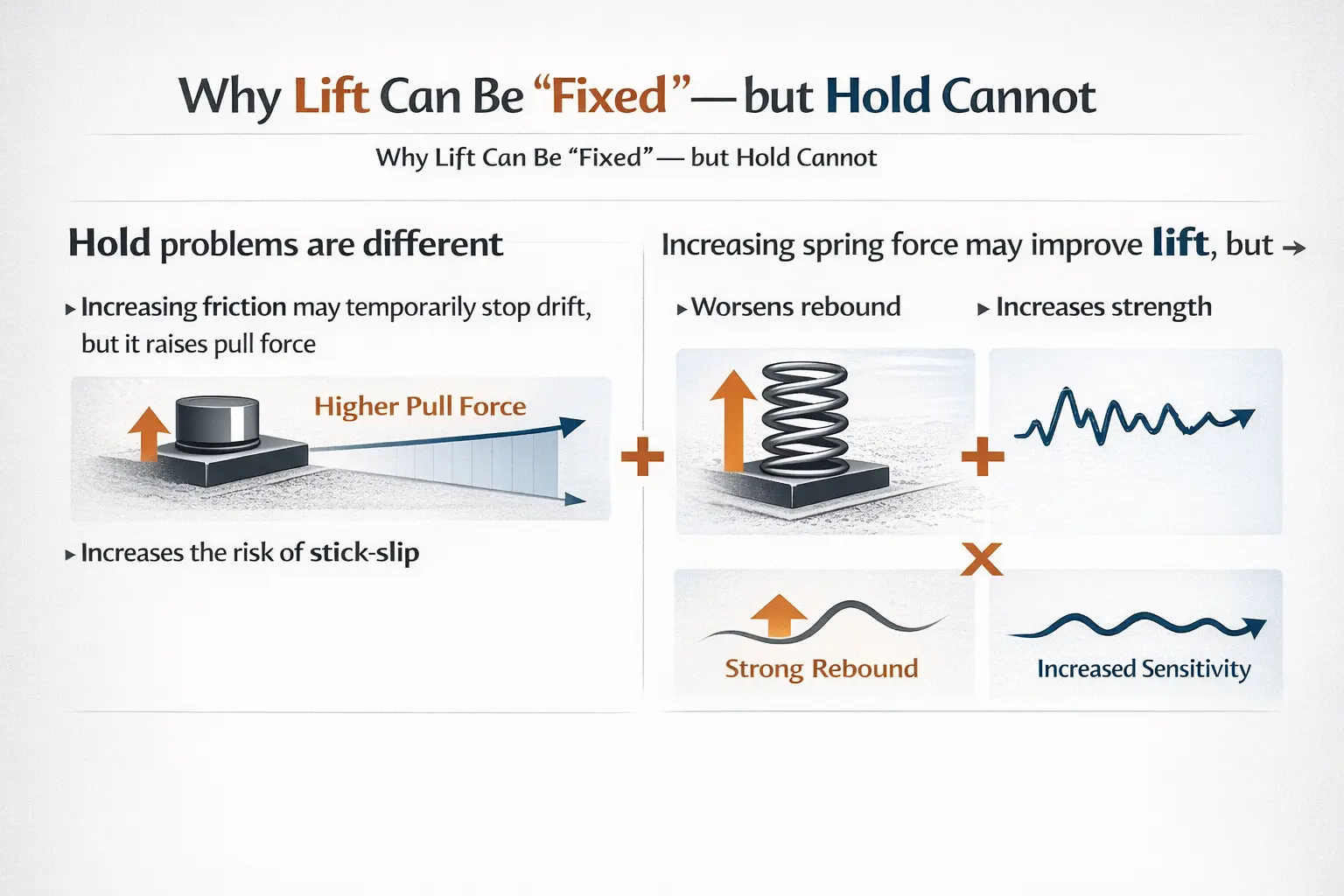
Hold problems are different.Increasing friction may temporarily stop drift,but it raises pull force and increases the risk of stick-slip.Increasing spring force may improve lift,but worsens rebound and sensitivity.
In other words:
you can tune lift in isolation,
but you cannot tune hold without system balance.
If lift and hold require opposite adjustments,
the system is operating outside its stable force band.
5) How Width and Aging Expose Hold Failures
Wide blinds and long-term use are unforgiving.Width amplifies imbalance;aging shifts force relationships.
This is why systems that feel “perfect” at installation can develop complaints months later—
especially at larger sizes.
FAQ
Q1: Why does a blind lift smoothly but fail to hold?
A: Because lifting is a transient condition, while holding is a steady-state requirement.
A system only needs enough momentary force to move during lift, but holding demands continuous equilibrium between spring force, gravity, and internal resistance. Many systems are tuned to feel good in motion, not to remain stable at rest.
Q2: Is hold stability mainly a brake problem?
A: No. The brake does not create stability—it regulates motion within the force band defined by the spring.
If the spring output varies across travel or drifts over time, the brake can only mask symptoms briefly. It cannot correct an unstable force envelope.
Q3: Why do hold issues often appear near the top or bottom?
A: Because force balance is not uniform across the stroke.
At travel extremes, changes in wrap diameter, friction zones, preload geometry, and spring unwind angle expose weak stability regions that remain hidden at mid-travel.
Q4: Can user technique affect hold performance?
A: In cordless systems, user input is minimal and largely irrelevant.
Persistent drift, rebound, or sag almost always indicates internal imbalance, not handling error. Blaming user technique is usually a way to avoid addressing system-level design flaws.
Q5: Why are hold failures more common in wide blinds?
A: Because width turns the blind into a lever-amplified mechanical platform.
Small left–right force mismatches become visible tilt, and the system loses its ability to self-correct through friction averaging.
Q6: Why can a blind pass showroom tests but fail after installation?
A: Showroom tests are short, centered at mid-travel, and done under ideal conditions.
Real installations introduce full-stroke operation, gravity bias, mounting tolerances, and environmental variation—conditions where force band weaknesses finally surface.
Q7: Can increasing spring strength improve hold stability?
A: Often the opposite happens.
Over-strength springs widen the force band instead of stabilizing it, increasing brake dependency, pull force, and rebound risk. Stability comes from consistency, not magnitude.
Q8: Why do some blinds drift slowly instead of slipping suddenly?
A: Slow drift indicates the system is operating near equilibrium but outside the stability margin.
Micro-movements accumulate because spring force, friction, and brake resistance are not perfectly aligned over time.
Q9: Why do hold problems worsen after cycling or aging?
A: Because aging changes the internal balance:
springs relax, lubricants migrate, friction interfaces polish, and tolerances settle.
If spring output and braking authority were never matched as a system, aging simply makes the mismatch visible.
Q10: What is the most reliable way to ensure long-term hold stability?
A: Design the system so that:
-
spring output stays within a tight, flat force band
-
brake authority is matched to that band, not fighting it
-
stability is validated across full travel, production variation, and aging
Smooth lift is easy to demo.
Stable hold is an engineering decision.
Field Insight
Cordless systems feel simple because the interface is simple.
Internally, they are self-balancing machines.
Lifting motion is easy to demonstrate;
holding position is where engineering quality is revealed.
When a system can lift but cannot hold,
the problem is not usability—it is force balance.