
Dissecting the Top Rail of a Cordless Blind: The Precision Chassis Hidden in Plain Sight
 |
Quick Summary
The top rail (headrail) of a cordless blind is not “just a cover.” It is a space-constrained mechanical chassis that must keep the spring engine, spooling logic, brake/damper, and transmission shaft aligned under thousands of cycles. When integration is weak, you see the same failure trio: high operating force, drift/creep, and binding + noise. This teardown shows what’s inside, what typically fails, and how to design the headrail as a stable system (not a parts bucket) for OEM/ODM production.
Primary intent: reduce drift, stutter, noise, and warranty risk through headrail-level system integration.
Table of Contents
What’s Inside the Top Rail?
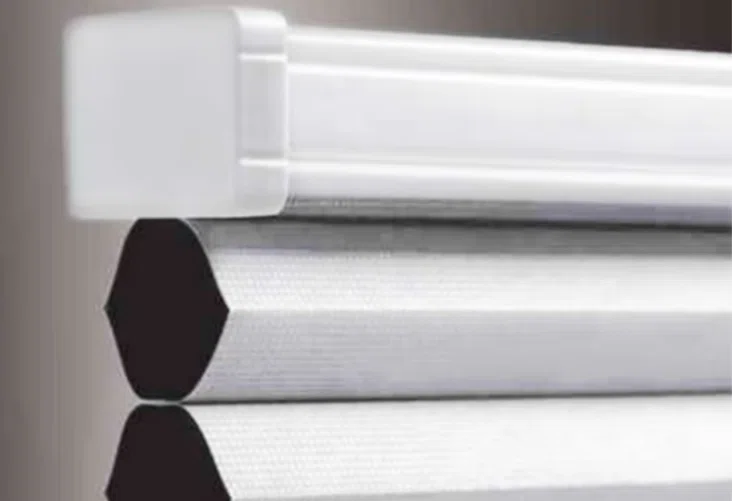
A cordless blind does not rely on an external hanging cord or chain for lift. The lift force and control live inside the headrail. In most cordless architectures, the top rail houses a drive stack with four jobs: store energy, convert torque, control speed, and hold position.
- Energy source: constant-force spring / spiral spring / spring box module (stores energy as you pull down; releases to lift).
- Transmission: shaft + drum/spool (turns spring torque into controlled lift motion).
- Speed & stability control: brake/damper (prevents slam-to-top, stabilizes rise rate, improves “premium feel”).
- Support interfaces: end-plugs, brackets, bearings (where small misalignments become big friction).
If you want a one-line definition for engineering reviews: the headrail is the alignment reference that decides whether your mechanism runs like a tuned system or fights itself for its entire life.
 |
1) Structural Rigidity & Extrusion Tolerances
Start with the aluminum profile. The headrail is effectively a long bearing block: it supports shaft centers and resists twisting/deflection. When rigidity is insufficient or extrusion tolerances drift, the mechanism sees misalignment under load, and misalignment shows up as friction.
The engineering risk: micro-misalignment becomes parasitic friction
- Uneven lift (“stutter”): the shaft line is not coaxial, so rotation alternates between smooth motion and rub.
- Noise: rubbing surfaces create squeaks/chatter; impact zones create knocks and bounce.
- Wear acceleration: small contact points become heat + debris + damage over cycle life.
Integration approach that scales in OEM production
- Tolerance-friendly interfaces: allow controlled “float” or self-centering so normal extrusion variation does not force a bent assembly.
- Defined datum strategy: decide which feature owns coaxiality (bracket seat, end-plug seat, or bearing pocket), then design everything else around it.
- Pre-load without distortion: clamp and fastening loads should not twist the headrail or squeeze parts into misalignment.
2) Torque Management: Flattening the Output Curve
This is the core physics behind “premium cordless feel.” Two curves must be reconciled: gravity/load behavior changes with extension and wrap geometry, while spring torque naturally varies as the spring winds/unwinds. Poor curve matching causes two classic symptoms: a blind that feels heavy at the bottom, or a blind that creeps up at the top.
Symptom → Likely cause → System-level fix
| User/Field Symptom | Likely Root Cause | What Actually Fixes It |
|---|---|---|
| Heavy pull-down near bottom | spring torque too low in that band; friction stack-up | spring selection/preload tuning + reduce misalignment friction |
| Creep-up near top | spring torque too high; brake stiction too low | flatten torque curve + increase controlled holding friction |
| Holds only at some heights | curve mismatch across stroke; spool radius changes from overlap | spooling geometry + curve tuning + consistent cord path |
| “Stutter” mid-travel | shaft not coaxial; brake transition abrupt | restore alignment + smoother static→dynamic friction behavior |
Practical takeaway: if your headrail geometry is unstable, you will never “tune your way out” of friction. Fix alignment first, then tune torque and damping.
3) Tribology & Spooling Logic
Tribology is where “quiet” lives or dies. Inside a narrow headrail, a weak spool/drum design can cause overlap, changing the effective radius and shifting required force. Overlap also creates binding, which users interpret as jerky motion or “cheap mechanics.”
Three high-frequency failure modes
- Overlap: cord stacks and changes moment arm, so force feel becomes inconsistent.
- Edge abrasion: cord rubs sharp edges or flash, shortening lifecycle and adding noise.
- Brake misbehavior: too sticky (high stiction) feels jerky; too loose fails to hold and causes drift.
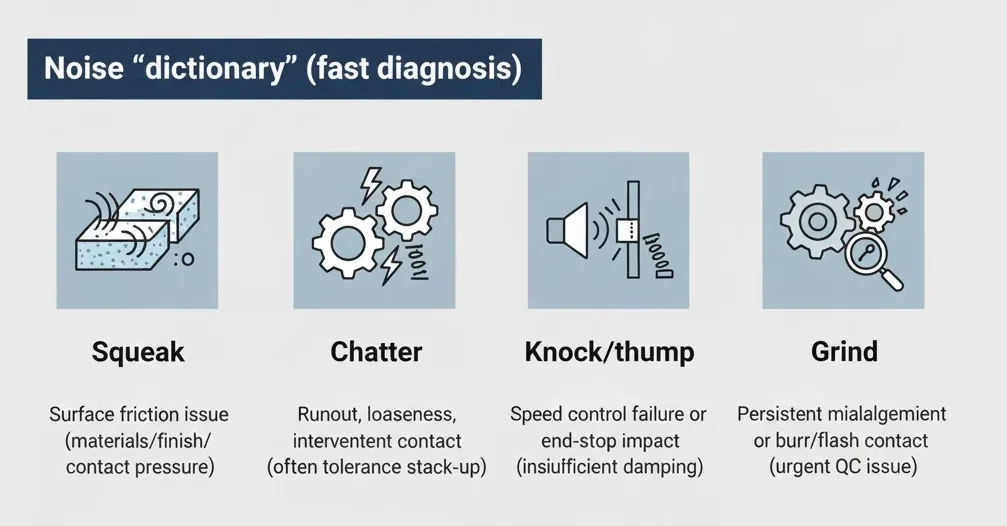 |
Noise “dictionary” (fast diagnosis)
- Squeak: surface friction issue (materials/finish/contact pressure).
- Chatter: runout, looseness, or intermittent contact (often tolerance stack-up).
- Knock/thump: speed control failure or end-stop impact (insufficient damping).
- Grind: persistent misalignment or burr/flash contact (urgent QC issue).
4) DFM: Assembly Logic That Survives Mass Production
A lab-perfect design that is hard to assemble is not a premium product; it’s a premium warranty. The headrail is where DFM determines whether your factory output is consistent or “operator-dependent.”
DFM patterns that reduce error rate
- Poka-yoke (mistake-proofing): keyed geometry that prevents reverse or off-axis installation.
- Module-first build: reduce loose parts, reduce SKU complexity, reduce tolerance chaos.
- Single adjustment logic: preload tuning should be measurable and repeatable, not “by feel.”
If you are sourcing components, ask one uncomfortable question early: “Can this headrail be assembled correctly by a new operator on day three?” If the honest answer is no, redesign the interfaces.
5) QC Tests: Fast Ways to Catch Headrail Integration Issues
You do not need a full lab to detect most headrail-level risks. The following checks are fast, repeatable, and directly tied to field failures.
| Test | What You’re Checking | Fail Signal |
|---|---|---|
| No-load rotation | shaft coaxiality and rub-free assembly | tight spots, scratch noise, inconsistent torque |
| Full-stroke winding trace | spool/drum logic and cord path stability | overlap, climbing, abrupt force changes |
| Hold-position check | drift/creep resistance at multiple heights | creep-up/creep-down within a short dwell |
| Rise behavior check | brake/damper tuning (speed control) | slam-to-top, bounce-back, or sluggish return |
| Sound fingerprint | friction vs looseness vs impact diagnosis | squeak/chatter/knock/grind patterns |
For OEM programs, the biggest ROI is usually: alignment discipline first, then torque curve matching, then tribology + damping refinement. Reverse that order and you’ll spend months “tuning around” a mechanical foundation problem.
FAQ
1) Does “cordless” mean there are no cords inside the blind?
Not always. “Cordless” typically means no external hanging cords/chains. Some systems still use internal lift cords or ladder structures depending on blind type, but the user-facing entanglement risk is removed.
2) Why does a cordless blind drift (creep up or creep down)?
Drift is a balance problem: spring output curve + load behavior + holding friction are not matched across the stroke. Fix alignment first, then tune torque and braking behavior.
3) What causes the “stutter” feel during lifting?
Most often shaft misalignment or an abrupt static-to-dynamic friction transition in the brake. Both are headrail integration issues, not “user error.”
4) Can I solve noise by changing materials only?
Materials help, but misalignment will still create rub points. Noise reduction is usually: geometry + finish + controlled friction pairing, in that order.
5) Why do some blinds feel heavy only at certain positions?
That’s often a spooling/radius consistency issue or torque curve mismatch. Overlap changes effective radius and shifts force feel mid-travel.
6) What is the fastest factory check before shipment?
No-load rotation + hold-position check at multiple heights catch a surprising percentage of future complaints before they leave your line.
7) How should OEM teams think about “premium feel” in engineering terms?
Consistent operating force, stable holding (zero/near-zero drift), controlled return speed, and low-noise friction behavior across cycle life.
8) Where does DOSRON fit in this system?
DOSRON focuses on modular cordless drive solutions designed for stable integration inside the headrail, helping OEM/ODM teams reduce tolerance sensitivity, drift risk, and assembly variability at scale.
Field Insight
If your cordless blind program is fighting drift, stutter, or noise, treat the top rail as a precision chassis. The most reliable OEM path is simple (but not easy): lock shaft alignment with tolerance-friendly interfaces, flatten the spring output curve to match the load band, and engineer friction/damping so the blind holds position without feeling sticky. Do that, and your product stops behaving like a mechanism and starts behaving like a premium interior component.