
Pre-Tensioned Constant Force Spring Modules for OEM Headrails
 |
Quick Summary
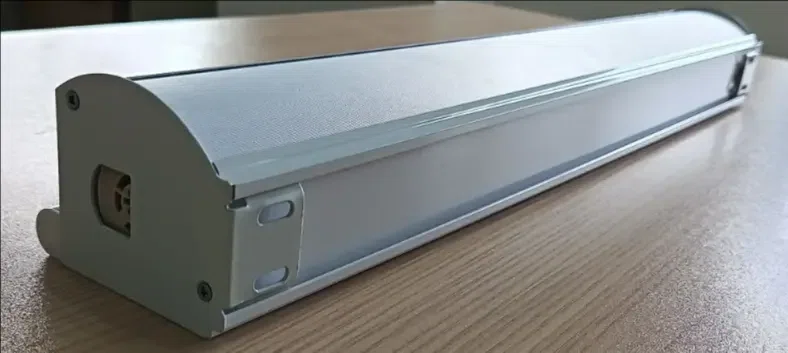
The DOSRON Pre-Tensioned Constant Force Spring Module is a headrail-ready lift core for OEM programs that need
repeatable cordless lift feel, stable holding at mid-height, and less line-side tuning.
“Pre-tensioned” means the spring pack ships with a defined initial bias—so your production doesn’t depend on operator intuition to hit the same lift performance across batches.
1. Product Positioning for OEM Headrail Programs
This module is designed for headrail architectures where “cordless” means no exposed operating cords (cords, if used, are internal and protected within the headrail).
It fits OEM roadmaps that prioritize child-safe operation, clean front aesthetics, and a more premium “controlled motion” feel.
 |
 |
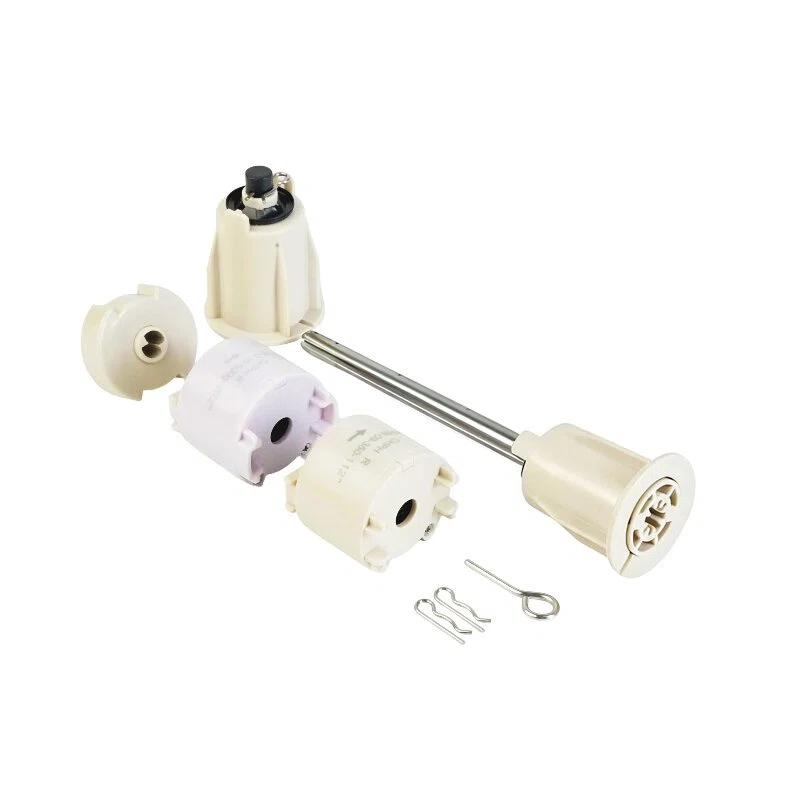
2. Drive System (Hidden Inside the Headrail)
Think of the headrail as a space-constrained mechanical chassis. The drive stack must generate lift, store/route internal cords (if applicable),
control speed, and keep left-right motion consistent—while surviving thousands of cycles with minimal friction drift.
| Component | What It Does | OEM Tuning Knobs | Practical Value |
|---|---|---|---|
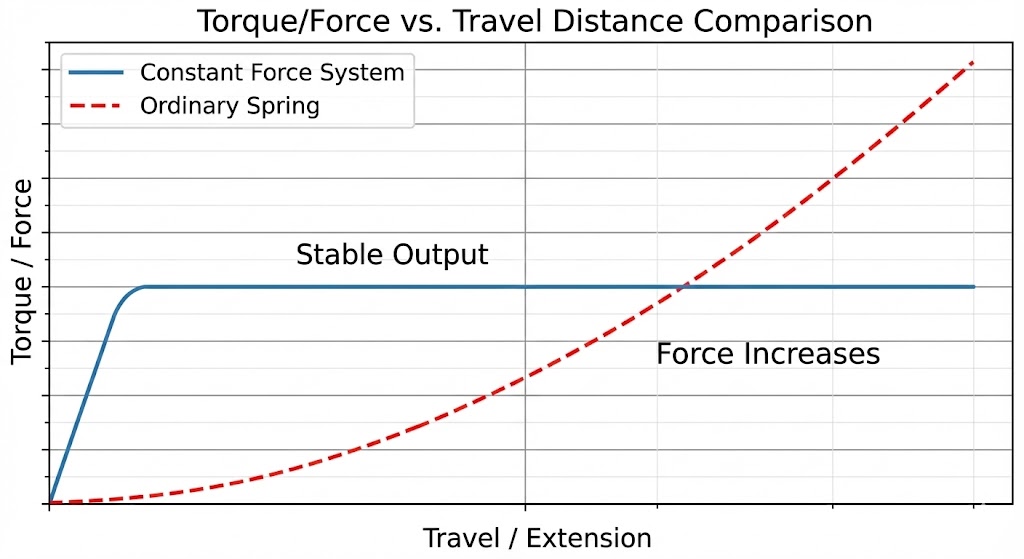
| Pre-Tensioned Constant Force Spring Pack | Provides lift balancing torque with a flatter force curve across travel. | Spring strip spec (thickness/width/count), output band (light/medium/heavy), initial bias index. | More consistent “hand feel,” less drift, fewer returns caused by mismatch. |
| Indexed Pre-Tension Interface | Locks the starting point so the spring works in the intended operating range. | Fixed index for single SKU, or multi-index for width/drop variants. | Reduces “operator-dependent” assembly variation and rework. |
| Lift Drum / Spool | Converts spring output into controlled lift motion (cord or tape routing). | Drum diameter, groove profile, surface finish, anti-overlap geometry. | Improves smoothness, reduces cord wear and “spool lock.” |
| Damper / Brake (Optional) | Controls rebound and prevents fast “snap-up” near the top. | Damping rate tuned by load band and drop length. | More premium dynamics; less top impact and noise. |
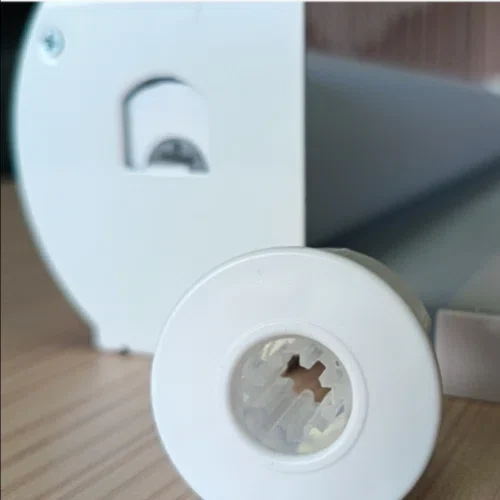
| Support Interfaces (End Seats / Bushings) | Keeps the axis aligned and friction stable over life. | Fit tolerance, material pairing, coaxiality control. | Prevents “it was smooth in QC, not smooth in the customer’s home.” |
Recommended Data Pack (What OEM Teams Should Record)
| Metric | Goal / Purpose | How to Verify |
|---|---|---|
| Hold-Position Stability | No drifting when stopped mid-height. | Stop at 25% / 50% / 75% height; measure displacement after a fixed dwell time. |
| Lift Smoothness | No stutter; no sudden speed changes. | Manual lift cycle test; compare across spring bands. |
| Anti-Tangle Performance | No cord pile-up or spool lock after repeated cycling. | Repeated lift cycles; inspect cord path and spool layering behavior. |
| Top Impact Protection | No harsh top impact during full-speed rise. | Fast-rise test; confirm damper engagement and final deceleration effect. |
3. Headrail Packaging & Interface (Where Most “Mystery Friction” Is Born)
Spring performance on paper is meaningless if the headrail packaging is sloppy. The module should be treated as an integrated drive stack:
spring band + drum geometry + alignment control + routing.
Small coaxial errors and sharp routing turns quietly turn into big customer complaints.
- Axis alignment: control end-seat fit and headrail straightness to prevent binding.
- Routing hygiene: avoid crossovers, minimize sharp bends, and keep guide surfaces consistent.
- Noise strategy: stable friction beats “super low friction” that changes after break-in.
4. Operation & Control (User Touch Points)
Your finished product may use a bottom-rail handle, discreet pull tab, or integrated grip profile. The module’s job is to keep the lift feel predictable:
light pull, stable stop, and no surprise recoil.
5. Connection & Installation Accessories (Keep Assembly Repeatable)
These parts carry load, guide motion, and ensure consistent assembly at scale—especially in headrails where internal cords exist but remain hidden. :contentReference
| Component | Role | OEM Considerations |
|---|---|---|
| Internal Lift Cord / Tape | Transfers lift motion from drum to load. | Use high-abrasion-resistant fiber; keep routing clean to reduce friction and noise. |
| Brackets | Mounting interface for headrail. | Match bracket to headrail profile; prioritize fast alignment and secure locking. |
| End Caps / End Seats | Protects ends and stabilizes drive axis. | Control fit tolerance to avoid rattling noise; keep edges tidy for a premium look. |
6. Configuration Matrix (A Public “SKU Logic”)
| Scenario | Load Band | Pre-Tension Strategy | Speed Control | Notes |
|---|---|---|---|---|
| Standard Residential Headrail | Light / Medium | Fixed index | Optional | Prioritize smooth startup and stable mid-position holding. |
| Wide Blinds / Higher Friction Routing | Medium | Multi-index | Recommended | Routing friction changes with width—multi-index helps keep feel consistent. |
| Heavier Bottom Rail / Blackout Builds | Medium / Heavy | Fixed + calibrated | Recommended | Use damping to avoid top impact and rebound. |
| Motor-Ready Upgrade Path | Project-defined | Keep spring band stable | By motor drive | Start cordless manual; add motor where automation is required. |
Motor-Ready Reference (Optional, For Hybrid Programs)
If your OEM line also needs a battery tubular motor option, the uploaded DT25 manual lists common reference specs such as
2600/5200 mAh battery, 5V charging, 25–28 RPM speed, 0.4–0.7 Nm torque, and IP20 protection class. :contentReference[oaicite:2]{index=2}
Operating temperature is specified as 0°C–40°C. :contentReference[oaicite:3]{index=3}
| Motor Model (Examples) | Battery (mAh) | Speed (RPM) | Torque (Nm) | Length (mm) | IP |
|---|---|---|---|---|---|
| DT25B1/28-32X | 2600 | 28 | 0.7 | 396 | 20 |
| DT25B2/25-38B | 5200 | 25 | 0.4 | 461 | 20 |
7. FAQ
What does “pre-tensioned” change versus a standard spring module?
It standardizes the initial bias point, which reduces batch-to-batch variability and shortens assembly tuning.
In other words: less “try it, re-hook it, try again.”
Why do some blinds still drift even with a strong spring?
Drift is usually a system mismatch: spring band vs real-world friction/load.
Cord routing, axis alignment, and bottom-rail weight distribution matter as much as the spring pack itself.
Do constant force spring modules eliminate internal cords?
Not necessarily. Many headrail architectures still use internal cords/tapes for lift transmission; “cordless” typically targets the removal of exposed operating cords.
What are the most common failure points you design around?
Cord abrasion, spool layering issues, and friction drift caused by tolerance stack-up.
Clean routing + stable interfaces + anti-tangle geometry is the practical trio.
Field Insight
In mass production, “cordless lift feel” is rarely solved by a stronger spring. It’s a system balancing problem:
spring band selection + pre-tension control + routing friction + alignment tolerance.
Treat those as one stack and your headrail platform will feel immediately more premium—quiet, smooth, and controlled.