
OEM Cordless Venetian Blind Accessories & Drive System Components
Quick Summary
Built for OEM fabricators, this cordless Venetian blind component platform is organized into four standardized modules:
(1) Drive system (constant-force spring lift),
(2) Structural parts (headrail / bottom rail / slats / valance),
(3) User controls (handle + tilt wand), and
(4) Installation accessories (ladder tape, internal lift cords, brackets, end caps). It delivers a balanced lift with no exposed operating cords and a controlled, non-snapping “premium” motion feel. (Yes—“cordless” here means “cords with better manners.”)
1. Product Positioning for OEM Assembly
This page describes a standardized component architecture for cordless Venetian blinds. Here, “cordless” means the lift cords are internal (hidden) rather than fully removed. The blind keeps the classic slat + ladder structure, while eliminating the exposed operating cords that create tangling, usability friction, and safety risk.
 |
|
2. Drive System (Hidden Inside the Headrail)
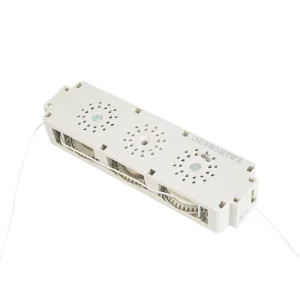
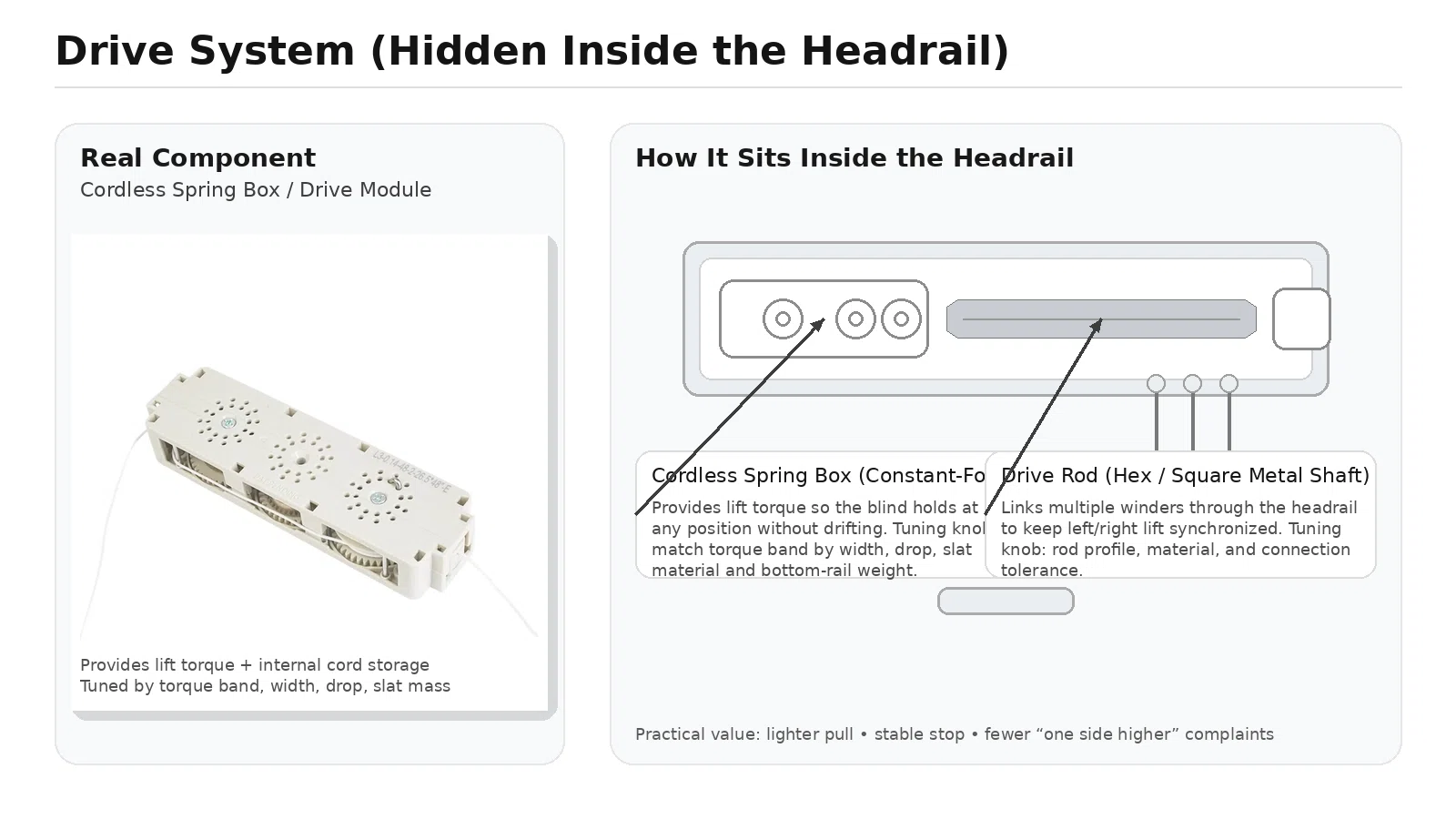
The drive system is the blind’s “power room.” It provides lift torque, cord storage, speed control, and left-right balance across the blind width. A typical cordless Venetian blind setup includes the following:
| Component | What It Does | OEM Tuning Knobs | Practical Value |
|---|---|---|---|
| Cordless Spring Box (Constant-Force System) | Provides lift torque; enables the blind to hold at any position without drifting. | Match torque band by width, drop, slat material, and bottom-rail counterweight. | Defines the “hand feel”: light pull, stable stop, minimal bounce-back or drop. |
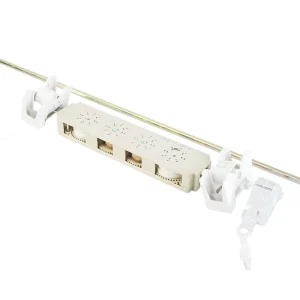
| Drive Rod (Hex / Square Metal Shaft) | Runs through the headrail to link multiple winders; keeps left/right lift synchronized. | Rod profile, material (steel/aluminum), connection tolerances. | Reduces “one side higher” complaints; improves stability on wide blinds. |
Recommended Data Pack (What OEM Teams Should Record)
| Metric | Goal / Purpose | How to Verify |
|---|---|---|
| Hold-Position Stability | No drifting (downward slip / upward rebound) when stopped mid-height. | Stop at 25% / 50% / 75% height; measure displacement after a fixed dwell time. |
| Lift Smoothness | No stutter; no sudden speed changes. | Manual lift cycle test; compare performance across torque bands. |
| Anti-Tangle Performance | No cord pile-up or spool lock after repeated cycling. | Repeated lift cycles; inspect cord path and spool layering behavior. |
| Top Impact Protection | No harsh top impact during full-speed rise. | Fast-rise test; confirm damper engagement and final deceleration effect. |
 |
3. Structural Components (The Visible Framework)
Structural parts define compatibility with the slat system and determine how much space is available to package the drive system. For cordless designs, their influence on weight balance is especially critical.
| Part | Typical Construction | Options / Notes | Publicly Shareable Data |
|---|---|---|---|
| Headrail | U-channel steel or aluminum profile that houses the drive system. | High profile / low profile encapsulation formats. | Common in the U.S.: 2-inch headrail (approx. 50.8 mm). |
| Bottom Rail | Weighted bottom bar. | Cordless structures typically use a heavier bottom rail or internal steel weight to balance spring force. | Publish weight grades by slat set: light / medium / heavy. |
| Slats | Faux wood (PVC), real wood, or aluminum. | Material drives total system mass and the correct spring torque selection. | Publish slat material + thickness range (defined by OEM). |
| Valance + Clips | Decorative cover that hides the headrail. | Clip geometry must match the headrail profile. | Publish compatible headrail profiles: high / low. |
4. Operation & Control Hardware (User-Touch Parts)
For cordless lifting, the user typically lifts and lowers the blind by gripping a handle on the center of the bottom rail. For light control (tilting), Venetian blinds typically use a rigid tilt wand to avoid exposed cords.
| Control Part | Function | Design Focus |
|---|---|---|
| Handle | Primary lift interaction point; user pinches and moves the blind up/down. | Ergonomic shape; transparent or color-matched options to keep a clean appearance. |
| Tilt Wand | Cord-free slat rotation (light control). | Preferred for cord-safety-focused lines; delivers consistent rotational “feel.” |
| Tilter Mechanism | Hidden in the headrail; converts wand rotation into ladder/slat movement. | Low backlash + stable engagement to prevent uneven slat angles. |
5. Connection & Installation Accessories
These parts carry load, guide motion, and ensure consistent assembly at scale. “Cordless” does not mean “no cords”—it means the cords are internal, so there is no external entanglement risk.
| Component | Role | OEM Considerations |
|---|---|---|
| Ladder Tape / Ladder Cord | Supports slats and transmits tilting action. | Wide tape vs thin cord depends on style positioning; confirm compatibility with the tilter. |
| Internal Lift Cord | Hidden cords routed through slats/ladder structure. | Use high-abrasion-resistant fiber; keep routing clean to reduce friction and noise. |
| Brackets | Top-mount or side-mount support hardware. | Match bracket to headrail profile; prioritize fast alignment and secure locking. |
| End Caps | Plastic covers for headrail and bottom rail ends. | Control fit tolerance to avoid rattling noise; keep edges tidy for a more premium look. |
 |
|
6. Configuration Matrix (A Public “SKU Logic”)
| Scenario | Slat Material | Headrail Profile | Lift Power | Tilt Control | Notes |
|---|---|---|---|---|---|
| Standard Residential | Faux Wood (PVC) | 2-inch high profile / low profile | Light / Medium torque band | Tilt wand | Match a moderate bottom-rail weight for balanced feel. |
| Premium Faux Wood | Heavy-duty PVC or composite | 2-inch high profile | Medium / Heavy torque band | Tilt wand | Add a damper for controlled rise and more premium dynamics. |
| Real Wood Series | Real wood | 2-inch high profile | Heavy torque band | Tilt wand | Confirm anti-tangle spool + internal routing design for durability. |
| Aluminum Venetian | Aluminum slats | Low-profile option | Light / Medium torque band | Tilt wand | Prioritize quiet cord travel and stable tilter engagement. |
7. FAQ
Do cordless Venetian blinds really have “no cords”?
No. Lift cords still exist, but they are internal and not exposed, which significantly reduces entanglement and safety risk.
Why is the bottom rail more important in cordless designs?
Because cordless lift relies on balance between spring force and gravity. A heavier bottom rail (or built-in steel weight) improves stability and “feel.”
What prevents the blind from snapping upward too fast?
A damper / speed reducer slows the rise and reduces top impact, creating a more controlled, premium motion feel.
How do you keep left and right sides level during lift?
A drive rod runs through the headrail to link multiple winders, keeping lift synchronized and level across the width.
Why use a tilt wand instead of a cord for tilting?
Tilting is typically handled by a wand, so the external control zone remains cord-free while still offering precise slat angle control.
What are the most common long-term failure points?
Poor internal routing (high friction), low-quality fibers, and cord winder tangling. Strong materials + clean routing + anti-tangle winder geometry form a practical “three-part” solution.
Field Insight
This is a system balancing problem involving four linked factors: torque band selection, bottom-rail counterweight, anti-tangle winder geometry, and drive-rod connection tolerances. Treat them as one integrated solution and your Venetian blind line will immediately feel more premium—quiet, smooth, and controlled, with fewer dramatic failures and less violent rebound.