
Navigating the CPSC Compliance Minefield: Why Your Braking System Is the First Line of Defense Against Recalls
In today’s U.S. market, recalls are rarely triggered by springs alone.
They are triggered by what happens when spring energy is released without control.
Quick Summary
CPSC recalls in cordless window coverings are no longer driven by missing certificates,
but by real-world failure modes: excessive pull force, slam-up rebound, drift, and noise.
Across nearly all cases, the braking system—not the spring—is where these failures first become visible.
A properly engineered brake is the system’s final safeguard against uncontrolled energy release,
aging drift, and liability-triggering behavior in the field.
1. Why CPSC Enforcement Has Shifted from Compliance to Behavior
For years, passing ANSI/WCMA test protocols was considered “safe enough.”That assumption no longer holds.
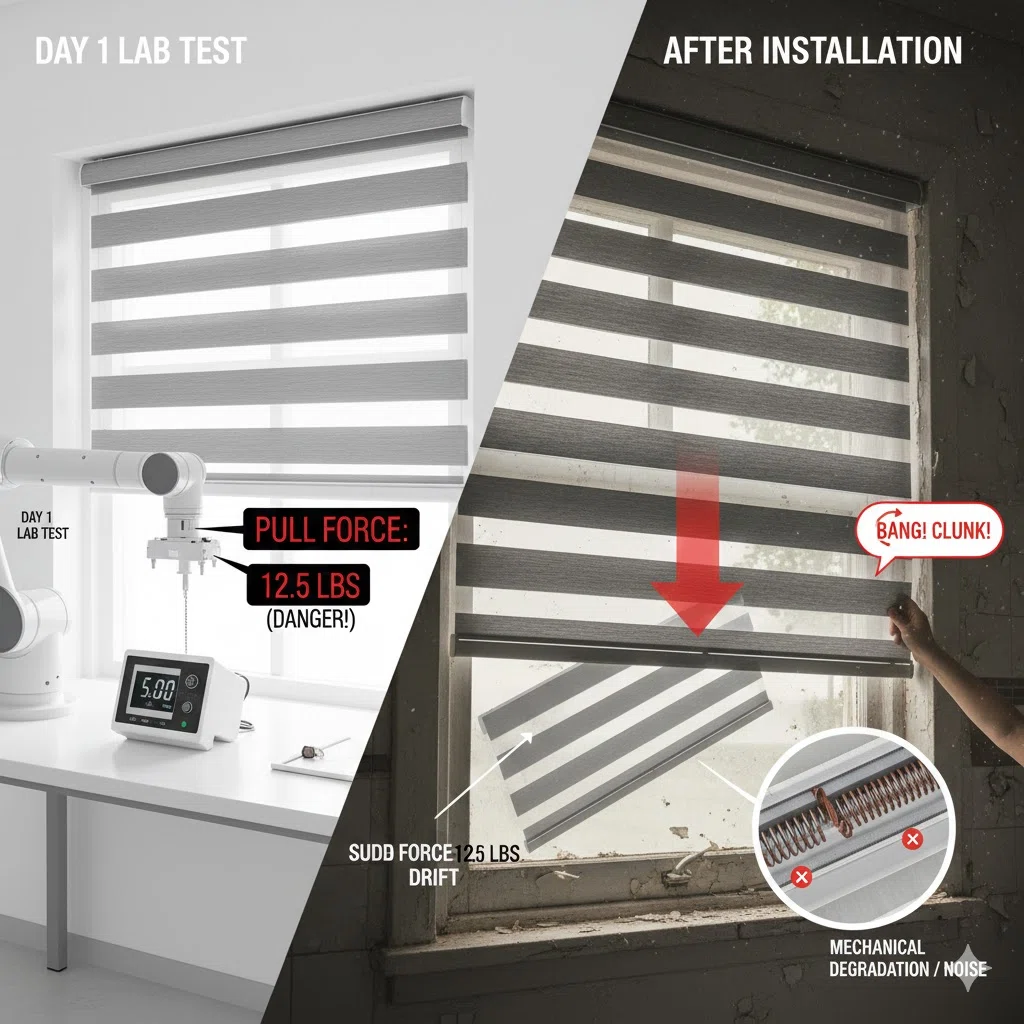
Under enforcement patterns from products are increasingly evaluated based on how they behave after installation—not how they performed on day one in a lab.
 |
 |
Key field behaviors now under scrutiny include:
- Downward pull force exceeding acceptable human limits
- Sudden top rebound (“slam-up”) after release
- Mid-height drift or inability to hold position
- Noise indicating mechanical degradation or instability
None of these are spring-only problems.They are energy control failures.
Under enforcement patterns from
products are increasingly evaluated based on how they behave after installation—
not how they performed on day one in a lab.
Typical Field Failure Thresholds Observed by CPSC
| Failure Mode | Observed Threshold | User / Regulator Concern |
|---|---|---|
| Downward Pull Force | > 35–40 N | Exceeds comfortable hand force for children and elderly users |
| Top Rebound Speed (Slam-Up) | > 0.30 m/s | Impact risk, sudden energy release |
| Mid-Height Drift | > ±5 mm over 60 s | Loss of position control, perceived instability |
| Operational Noise | > 40 dB | Indicates friction instability or mechanical degradation |
Source: CPSC post-market investigation summaries, ANSI/WCMA A100.1 user force guidance,
and field data aggregated from U.S. cordless window covering recalls (2019–2024).
This shift mirrors what we explore in detail in our broader compliance analysis:
maintenance-free cordless lift systems
,where long-term behavior now defines regulatory risk.
2. The Hidden Reality: Springs Create Risk, Brakes Contain It
Springs store energy.
Brakes decide whether that energy is released safely—or dangerously.
In a cordless system, the spring is intentionally oversized to ensure lift capability
across fabric tolerances, humidity changes, and aging.
This means:
- Stored energy is always higher than the minimum required
- Force decay is inevitable over time
- Friction conditions will change with wear
Without a properly engineered braking system, these realities lead to predictable failures:
- Excessive pull force as friction grows
- Slam-up events when spring output briefly exceeds damping capacity
- Drift and creep as holding torque collapses
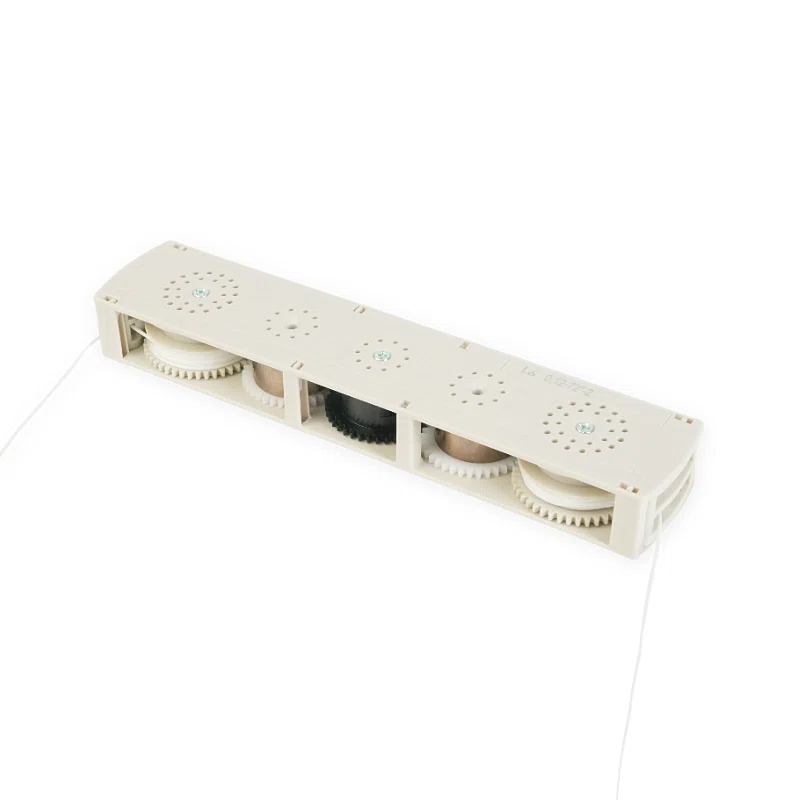
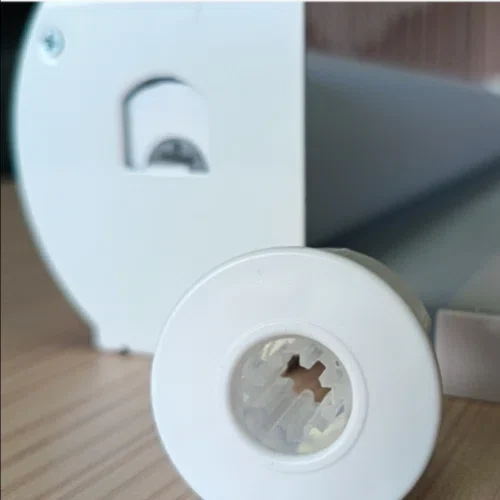
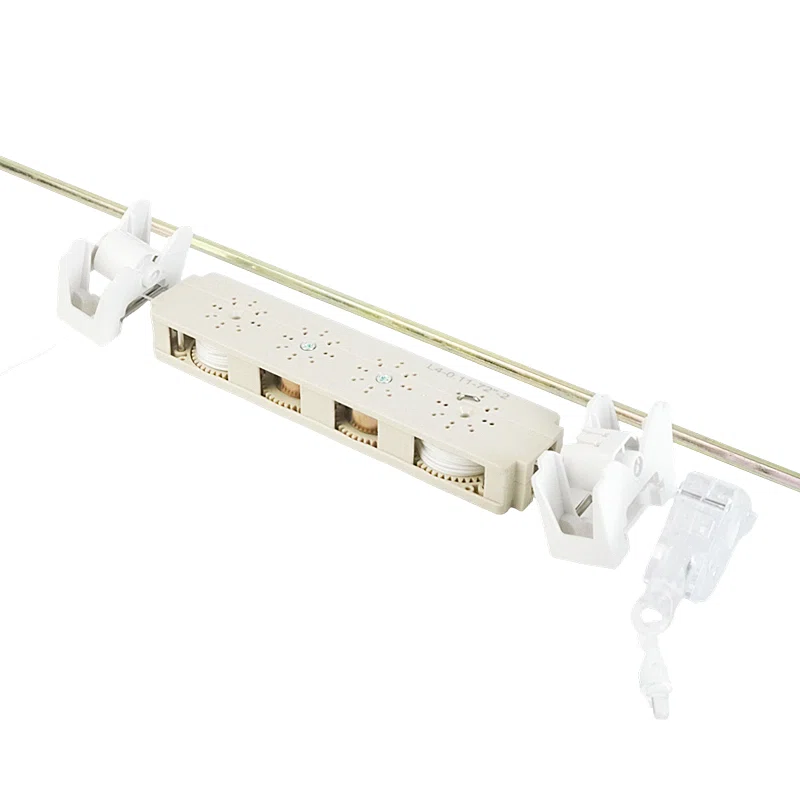
This is why CPSC-triggering incidents almost always manifest at the brake—not the spring.
 |
 |
Spring vs. Brake Responsibility in Recall Scenarios
| Failure Symptom | Spring Contribution | Brake Contribution |
|---|---|---|
| Excessive Pull Force | Force oversizing, aging drift | Friction growth, insufficient torque band |
| Slam-Up Rebound | Stored energy release | Lack of bidirectional damping |
| Mid-Height Drift | Force decay over cycles | Loss of holding authority |
| Noise After Aging | — | Stick-slip, surface polishing, lubrication loss |
Source: OEM field failure analysis, spiral spring & braking system aging studies,
and internal force-curve validation data from cordless lift system testing.
3. What CPSC Failure Investigations Reveal About Braking Systems
In post-market investigations, regulators rarely ask:
“Was the spring compliant?”
They ask:
- Why did the product accelerate near the top?
- Why did pull force increase after months of use?
- Why could the shade not hold position anymore?
Each question maps directly to braking behavior.Typical brake-related root causes include:
- Under-sized friction interfaces that polish smooth over time
- Single-direction braking that loses authority during rebound
- Brakes tuned independently from spring force curves
- No allowance for lubricant migration or contamination
Passing an initial test does not protect against these aging dynamics.Only system-level brake engineering does.
4. What a “Recall-Resistant” Braking System Actually Looks Like
A braking system designed for CPSC resilience must do more than slow motion.
It must remain stable across the product’s entire life.
Key engineering characteristics include:
- Bidirectional control – braking authority during both lift and release
- Wide torque band – tolerance for spring output variation
- Aging stability – predictable friction behavior after thousands of cycles
- Noise suppression – elimination of chatter and stick-slip
Critically, the brake must be validated together with the spring—not as a standalone component.
This is where many “compliant” systems fail in the real world.
A braking system designed for CPSC resilience must do more than slow motion.
It must remain stable across the product’s entire life.
Engineering Targets for Recall-Resistant Braking Systems
| Parameter | Recommended Range | Compliance Rationale |
|---|---|---|
| Holding Torque Band | ±10–15% of nominal spring output | Absorbs force variation due to aging and tolerance |
| Bidirectional Damping | Required | Controls both lift and rebound energy |
| Force Stability After Aging | < ±5% after 30k–50k cycles | Prevents drift and pull-force escalation |
| Operational Noise | ≤ 35 dB | Early indicator of mechanical health |
Source: ANSI/WCMA user interaction guidance, long-cycle aging tests,
and comparative OEM brake validation benchmarks.
5. Why Spring–Brake Co-Engineering Is Now a Compliance Requirement
In modern enforcement reality, compliance is no longer a document.
It is a behavior profile.
That profile is defined by:
- Force curves over time
- Energy release speed under worst-case conditions
- Stability after wear, dust, humidity, and misalignment
When springs and brakes are specified, tuned, or sourced independently,
their aging curves diverge—and failure becomes inevitable.
System-level validation is no longer “premium.”
It is the baseline for recall prevention.
FAQ: CPSC Compliance & Braking Systems
Q1: Can a stronger spring improve CPSC safety?
No. Stronger springs increase stored energy.
Without corresponding braking capacity, they raise recall risk.
Q2: Is noise considered a compliance issue?
Yes. Noise often signals friction instability or impact—both precursors to functional failure.
Q3: Why do products pass lab tests but fail in the field?
Lab tests do not simulate long-term aging, contamination, or tolerance drift.
Q4: Is braking more important than spring selection?
Neither works alone. The brake is the safety gate; the spring is the energy source.
Q5: What is the most common brake-related recall trigger?
Uncontrolled rebound or excessive pull force after wear-in.
Field Insight
CPSC recalls are rarely caused by catastrophic breakage.
They are caused by systems that age badly.
In cordless window coverings, the braking system is not a comfort feature.
It is the final authority that determines whether stored energy remains safe.
If your brake is not engineered as a compliance-critical component,
your spring will eventually put you on the wrong side of a recall notice.