
Variable Force Spring System for Premium Cellular Shades
Precision-engineered force control for zero-drift, silent, and luxury-smooth cordless operation.
Quick Summary
This Variable Force Spring (VFS) system is engineered specifically for cellular shades, where fabric stacking and bottom-rail mass change dynamically across the travel range.
By shaping a custom force curve instead of using a generic constant-force spring, the system delivers zero drift, stable mid-height holding, and a quiet, premium lift feel that meets North American cordless safety expectations.
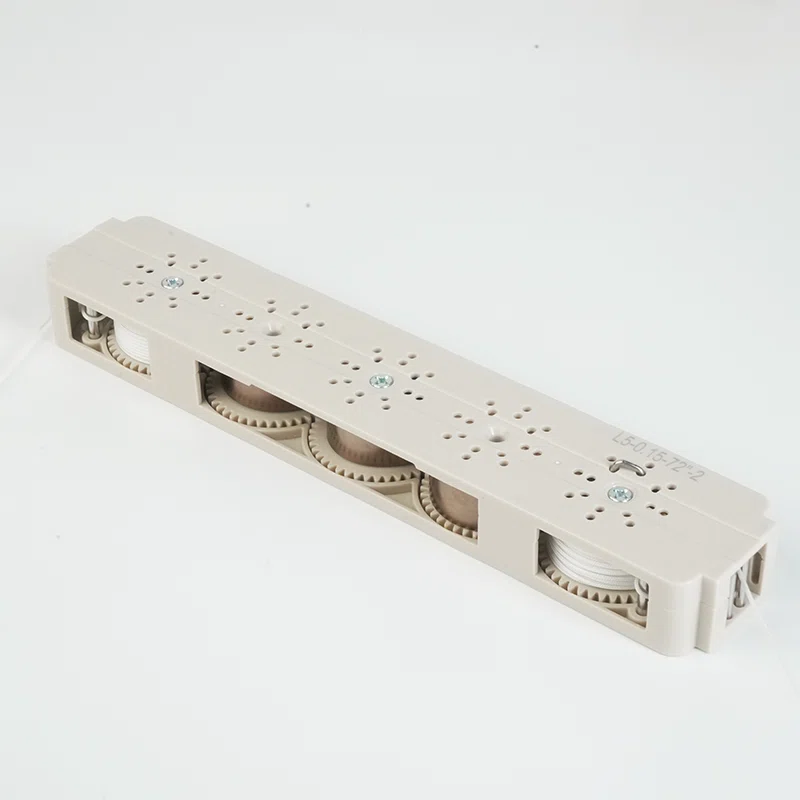
1. Product Overview — Engineered Balance, Not Guesswork
 |
|
Cellular shades present a unique mechanical challenge: as the shade moves, the effective load changes continuously due to fabric stacking geometry and bottom-rail mass distribution.
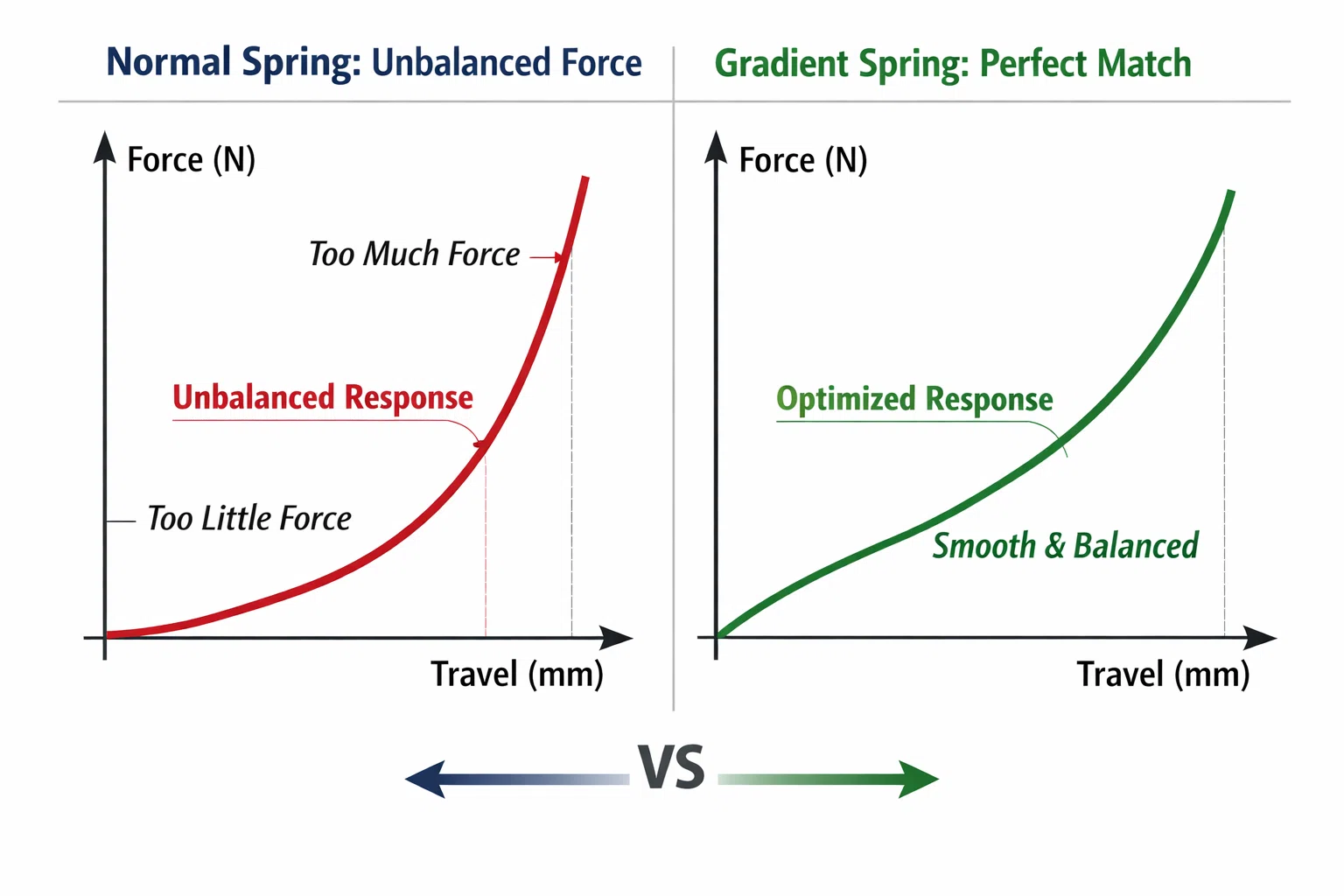
Standard constant-force springs cannot compensate for this shift, leading to drift, grab-release behavior, or top impact.
Our Variable Force Spring system solves this by using a custom-profiled torque curve that actively matches the load at each position, delivering controlled motion from fully retracted to fully extended.
2. Technical Excellence: Engineering the Perfect Balance
2.1 Optimized Force Curve Shaping
Unlike off-the-shelf constant-force springs, each VFS module is tuned for the exact operating window of your cellular shade platform.
- Zero-Drift Technology: Holds position precisely at any height—no creep, no rebound.
- Custom Torque Bands: Spring output is matched to fabric weight, cell depth, and headrail width.
- Progressive Compensation: Force output adapts as fabric stacks and load distribution shifts.
2.2 High-Performance Material Science
Durability and consistency define the core of the VFS platform. Material selection is driven by fatigue behavior, corrosion resistance, and acoustic performance—not cost shortcuts.
- 301 / 316 Stainless Steel: High fatigue resistance for long-cycle cordless operation.
- Advanced Surface Treatments: Passivation for humid environments; dry-film lubrication to eliminate metallic clicking and micro-chatter.
- Stable Friction Interfaces: Maintains consistent release behavior across temperature and humidity ranges.
 |
2.3 Precision Manufacturing & Geometry Control
Every spring cassette is manufactured with tight coaxial tolerances to prevent internal friction and torque loss.
- Coaxial Alignment Design: Reduces parasitic friction and uneven torque release.
- Luxury-Smooth Lift Feel: No snap-back, no sudden acceleration near top limits.
- Assembly Repeatability: Consistent hand-feel across production batches.
3. Technical Specifications (Typical)
| Parameter | Specification |
|---|---|
| Spring Type | Variable Force Stainless Steel Spring (Custom Profile) |
| Material Options | 301 SS / 316 SS |
| Cycle Life | 50,000+ full lift cycles |
| Noise Performance | < 40 dB (system-dependent) |
| Surface Treatment | Passivated / Dry-Film Lubricated |
| Compatibility | Cellular / Honeycomb Cordless Headrails |
4. Safety & Compliance
Designed to support compliance with the latest North American cordless safety requirements.
- ANSI/WCMA A100.1: Engineered for child-safe cordless operation.
- Zero External Cords: Eliminates entanglement risk by design.
- Stable Holding Force: Reduces unintended movement that may cause safety concerns.
5. OEM & Brand Value
- Platform-Specific Tuning: Springs designed to your exact shade architecture.
- Reduced Field Complaints: Eliminates drift, noise, and inconsistent lift feel.
- Premium Brand Perception: Smoothness and silence are instantly noticeable to end users.
- Scalable Production: Repeatable performance across SKUs and sizes.
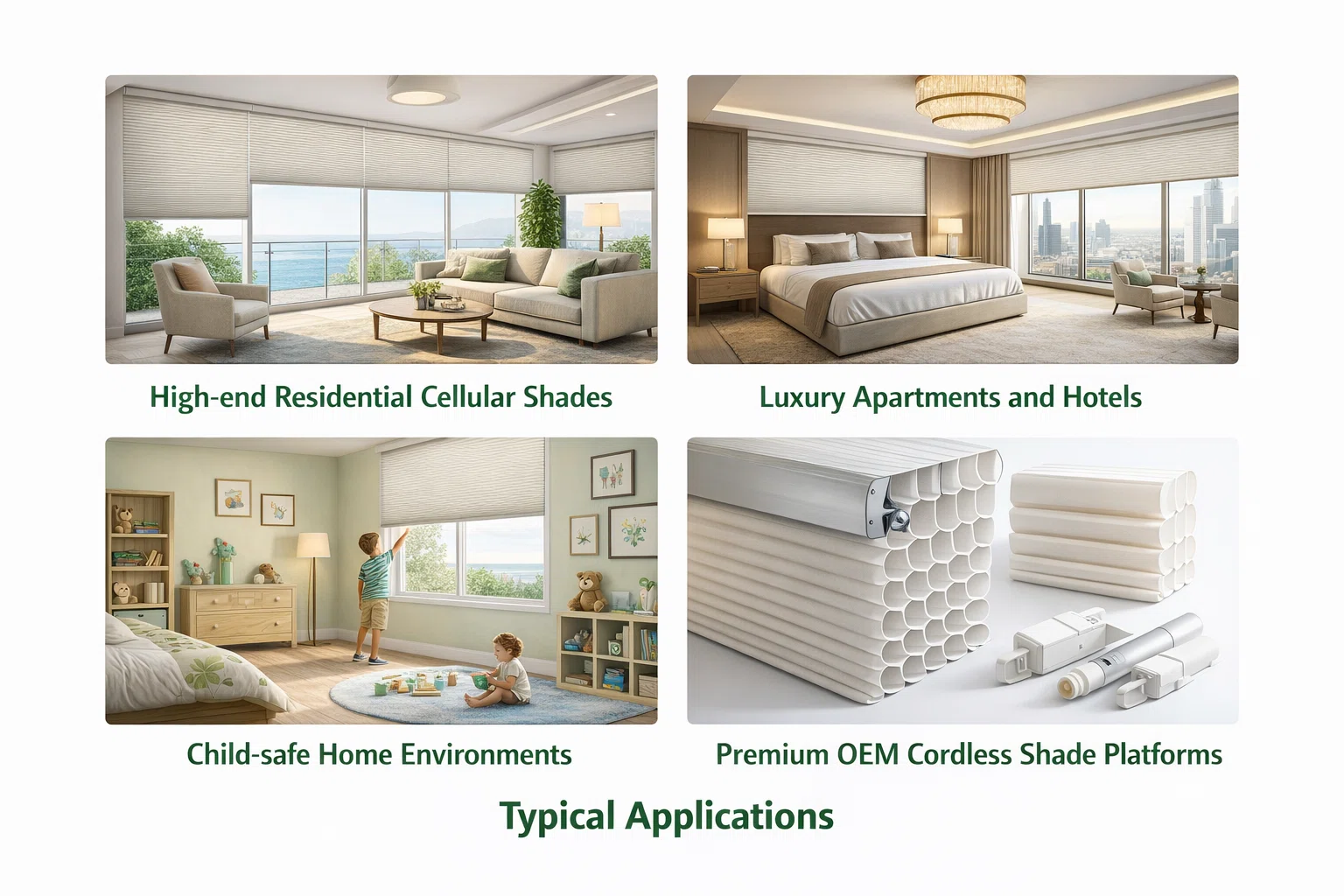
6. Typical Applications
- High-end residential cellular shades
- Luxury apartments and hotels
- Child-safe home environments
- Premium OEM cordless shade platforms
 |
7. FAQ Engineering Solutions for Cordless Shade Systems
Q1: Why not use a standard constant-force spring? A: Constant-force springs exert a uniform tension that doesn’t account for the weight change as cellular fabric stacks or unfolds. This often leads to “shade drift” (creeping up or falling down) and an inconsistent user feel. Our Variable Force Springs (VFS) are custom-profiled to match the exact load curve of your shade, ensuring a perfect “stop-and-stay” balance at any height.
Q2: Can the spring torque curve be customized for specific fabric types? A: Absolutely. We don’t believe in “one size fits all.” Our engineering team calculates the ideal torque curve based on your fabric’s weight, cell depth (9mm, 25mm, 38mm, etc.), and total travel length to ensure optimal lift ergonomics.
Q3: How do you ensure the longevity and cycle life of the springs? A: We use premium Grade 301/316 Stainless Steel with high-fatigue resistance. Every batch is sample-tested to exceed 50,000 to 100,000 cycles. We provide detailed cycle-test reports to help your brand meet long-term reliability guarantees.
Q4: Is this system compatible with motor-assisted or hybrid lift systems? A: Yes. Our VFS modules are frequently used in hybrid architectures where the spring handles the bulk of the lift load, reducing the strain on the motor. This allows for smaller, quieter motors and significantly extends battery life.
Q5: How does your spring system help with ANSI/WCMA compliance? A: Safety is non-negotiable in the US market. By eliminating accessible cords and providing a stable, reliable cordless mechanism, our system is a foundational component for achieving “Best for Kids” certification and compliance with the latest ANSI/WCMA A100.1 standards.
Q6: We’ve had issues with “metallic clicking” noises in the past. How do you solve this? A: Noise is often caused by friction between spring layers or improper cassette alignment. We use proprietary dry-film lubricants and high-precision POM/PA66 engineering plastics for the housing to ensure a whisper-quiet, premium “hand-feel” during operation.
Q7: What are the typical lead times for custom-engineered spring prototypes? A: We understand that project timelines are tight. For custom torque profiles, we can typically provide functional prototypes within 10-15 business days after finalizing the technical specifications and shade weight data.
Q8: Can your spring cassettes fit into slim or low-profile headrails? A: Yes. We offer several compact cassette geometries (including stacked and tandem configurations) designed to fit into modern, minimalist headrail pockets without sacrificing power or travel distance.
Q9: Do you provide technical support for assembly line integration? A: We provide more than just components. Our engineers provide integration consultation, including advice on shaft coaxiality, drum interfaces, and assembly tolerances to ensure your production line maintains high yield rates.
Q10: How do you handle force repeatability across large production batches? A: We implement strict SPC (Statistical Process Control). Each production lot is verified against the master torque curve with a target tolerance of ±5%, ensuring that every shade your customer buys feels exactly the same.
Field Insight
In premium cordless shades, users rarely describe torque curves—but they instantly feel the difference.
Stable mid-height holding, silent travel, and smooth deceleration are not features; they are expectations.
Variable force engineering is what separates commodity cordless systems from true luxury performance.