
Corrosion-Resistant Power Springs for High-Humidity Environments
Engineered constant-force “power spring” strips that maintain stable lift performance where moisture, salt air, and condensation destroy standard springs.
Quick Summary
DOSRON corrosion-resistant power springs are designed for high-humidity and coastal installations where conventional spring steel quickly develops rust, pitting, squeak, and force drift.
By combining stainless / coated spring materials, passivation/electropolish options, and edge + surface conditioning, the spring output stays predictable across cycles, reducing mid-height drift and “snap-back” behavior in cordless shades.
1) Product Overview
 |
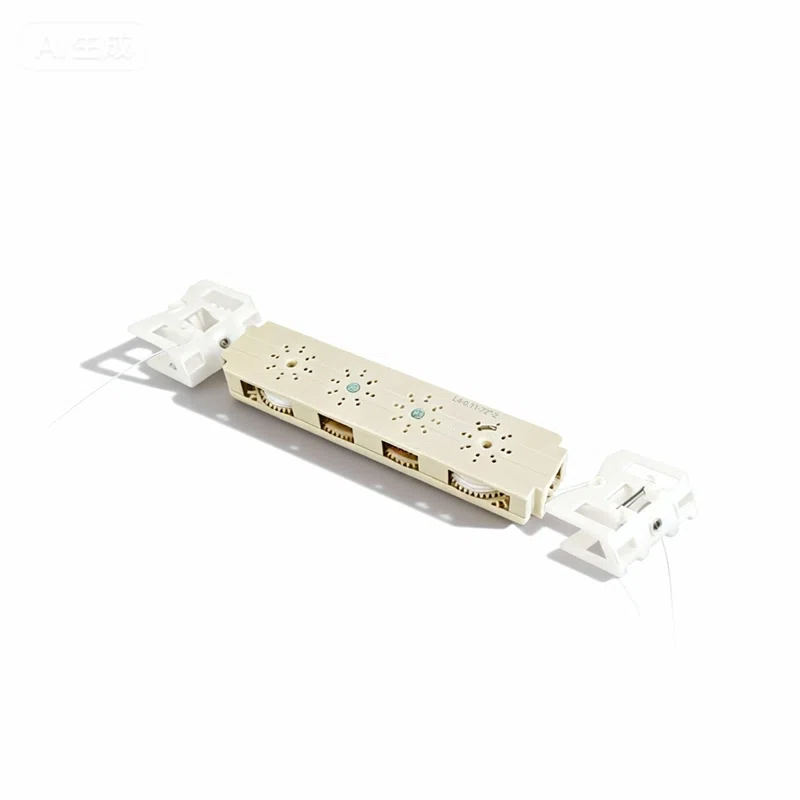 |
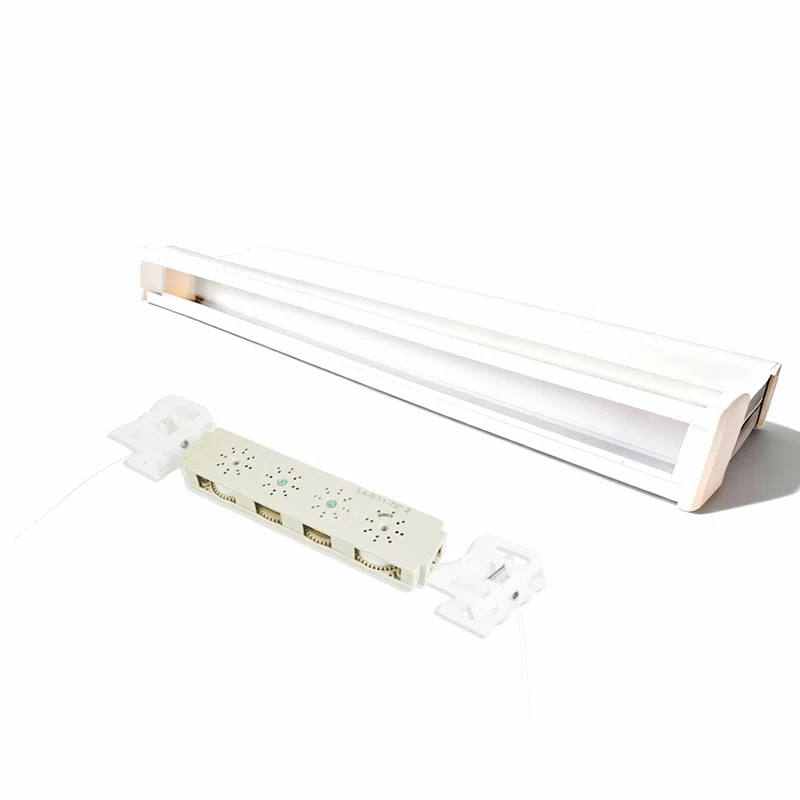
“Power spring” here refers to a constant-force spring strip (pre-coiled band) used as the energy source in cordless lift systems, spring modules, and spring-assisted motor platforms.
In humid environments (bathrooms, kitchens, seaside homes, tropical markets), spring corrosion is not cosmetic—it changes friction, reduces effective force, increases noise, and can trigger early fatigue cracks.
2) Why High Humidity Kills Standard Springs
- Pitting & crevice corrosion form stress concentrators, accelerating fatigue failure under cyclic bending.
- Force drift occurs when surface oxidation increases inter-wrap friction and changes the spring’s release behavior.
- Noise (squeak/chatter) rises as roughness increases and lubrication films are displaced by moisture.
- Inconsistent lift feel appears as “grab-release,” mid-height creep, or sudden top impact if damping is tuned for a healthy spring but the spring output degrades.
3) Engineering Approach for Corrosion Resistance
3.1 Material Options (Select by Environment Severity)
| Option | Best For | Notes |
|---|---|---|
| 301 Stainless | General humid interiors | Balanced cost/performance, good fatigue behavior when properly processed. |
| 316 Stainless | Coastal / salt-air exposure | Improved pitting resistance for chloride-heavy atmospheres. |
| 17-7PH Stainless | Higher stress + humidity | Higher strength potential; used when force density must stay high. |
| Coated High-Carbon Spring Steel | Cost-sensitive SKUs with controlled moisture risk | Requires robust coating + edge sealing discipline; not ideal for salt air. |
3.2 Surface Protection & Friction Control
- Passivation / electropolish (stainless): reduces free iron and smooths micro-asperities to lower squeak risk.
- Dry-film lubrication (optional): stabilizes inter-wrap friction for consistent release feel after moisture cycling.
- Barrier coatings (optional): e-coat/epoxy or PVD-like coatings to improve corrosion resistance where salt mist is present.
- Edge conditioning: deburr + controlled edge radius to reduce coating breaks and crack initiation sites.
3.3 Module-Level Moisture Design (If Using Cassettes)
- Sealed or semi-sealed spring cassette options to reduce direct splash and condensation pooling.
- Drain/vent features to avoid trapping moisture inside the module (yes, springs hate saunas).
- Polymer interface selection (POM/PA variants) to minimize water-driven friction spikes and noise.
4) Typical Technical Specifications (Configurable)
Final values depend on strip width/thickness, coil diameter, and required force curve. Below is a practical OEM spec band for quoting and early engineering checks.
| Spring Type | Constant-force power spring strip (pre-coiled band) |
| Material Options | 301 / 316 / 17-7PH stainless, or coated high-carbon spring steel |
| Strip Thickness (typ.) | 0.10–0.30 mm (application dependent) |
| Strip Width (typ.) | 6–20 mm |
| Force Output Band (typ.) | 10–60 N (single spring), higher with multi-spring stacks |
| Cycle Life Target (typ.) | 10,000–30,000 cycles (design + stress level dependent) |
| Humidity Exposure Target (typ.) | 85% RH durability programs (per OEM validation plan) |
| Salt-Fog Screening (optional) | Validation aligned to ASTM B117 / ISO 9227 (duration per project) |
| Operating Temperature (typ.) | 0–40°C (platform dependent) |
5) Where These Springs Fit Best
 |
|
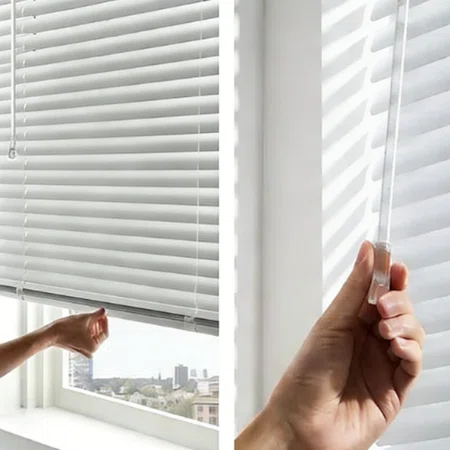
- Bathrooms / kitchens: frequent condensation and cleaning chemicals.
- Coastal residential & hospitality: salt air, chloride corrosion risk, long-service expectations.
- Pool / spa areas: high humidity + splash risk (recommend cassette + drainage approach).
- Tropical export markets: year-round high RH with temperature cycling.
6) Integration Notes for OEM Platforms
- Cordless lift modules: stable spring output simplifies brake/damper tuning and reduces mid-height drift.
- Roller / zebra / honeycomb: compatible with common headrail/tube architectures via adaptor and cassette geometry.
- Hybrid spring + motor: spring corrosion stability matters because motor current spikes when friction rises; stable springs help keep current and noise predictable.
7) Quality Control That Actually Catches Humidity Failures
- Material verification: thickness, tensile band, hardness, surface condition (and coating thickness where used).
- Edge inspection: burr control + edge radius consistency to reduce crack initiation.
- Force curve sampling: force vs extension checks at defined travel points (initial, mid, end).
- Moisture screening: humidity soak + functional cycling to detect squeak, friction jumps, and force drift.
- Salt-fog spot checks (coastal SKUs): validate corrosion resistance per agreed duration and acceptance criteria.
8) Customization Options
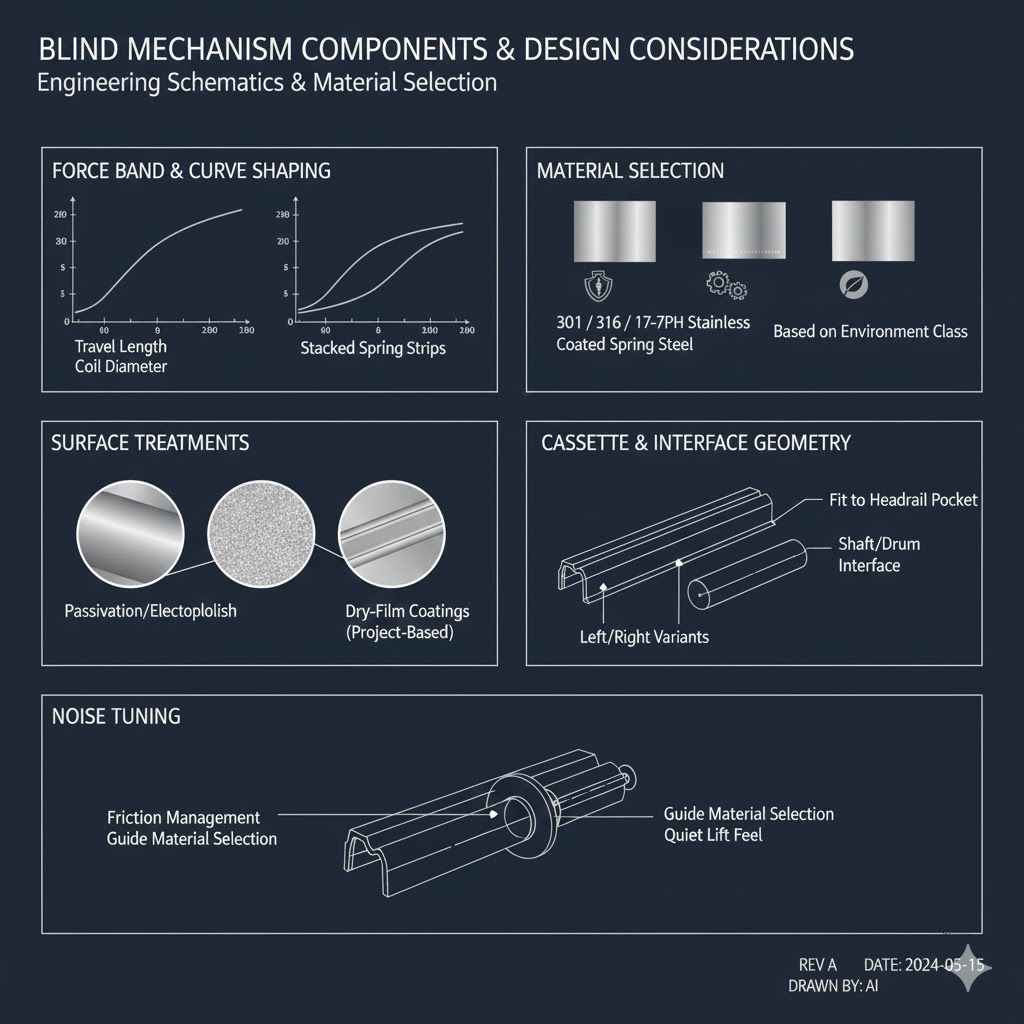
- Force band & curve shaping: single vs stacked spring strips, travel length, coil diameter.
- Material selection: 301 / 316 / 17-7PH stainless or coated spring steel based on environment class.
- Surface treatments: passivation/electropolish, dry-film lube, barrier coatings (project-based).
- Cassette & interface geometry: fit to your headrail pocket, shaft/drum interface, left/right variants.
- Noise tuning: friction management and guide material selection for quiet lift feel.
 |
9) FAQ
Q1: What “humidity level” is considered high?
A common OEM threshold is sustained exposure around ≥80–85% RH with condensation risk, plus temperature cycling that drives moisture into crevices.
Q2: Is stainless always enough?
Not always. In salt-air (chloride) environments, upgrading from 301 to 316 (and adding surface finishing) usually provides better pitting resistance.
Q3: Why do springs start squeaking after months in humid homes?
Moisture changes inter-wrap friction and can wash away lubrication films. Surface smoothing + controlled lubrication options keep friction more stable.
Q4: Will corrosion affect lift force?
Yes. Corrosion increases friction and changes release behavior, often showing up as higher pull force, mid-height drift, or jerky rise.
Q5: Do I need a cassette in bathrooms?
If the spring sits near condensation zones, a cassette with drain/vent strategy is usually safer than leaving the spring exposed in a “moisture trap.”
Q6: What tests should an OEM request?
At minimum: force-curve sampling, humidity soak + cycling, noise checks, and (for coastal SKUs) salt-fog screening aligned to ASTM B117 / ISO 9227.
Q7: Can these springs be used in motorized shades?
Yes. Stable spring friction helps reduce motor load variability, improving perceived smoothness and reducing current spikes in humid deployments.
Q8: What info do you need for selection?
Blind type, width × drop, fabric + bottom rail mass, target “hand feel” (pull force), headrail/tube geometry, and environment class (indoor humid vs coastal salt-air).
Field Insight
High humidity failures usually look like “random quality issues,” but they’re predictable: corrosion increases friction, friction drives force drift, and force drift triggers user complaints.
If you classify environments (standard indoor / humid indoor / coastal), then match material + surface + cassette design to that class, your spring platform becomes more stable, quieter, and easier to mass-produce without mystery returns.