
Low-Friction Wand Tilt Braking System for Heavy-Duty Cordless Horizontal Blinds
 |
 |
Quick Summary
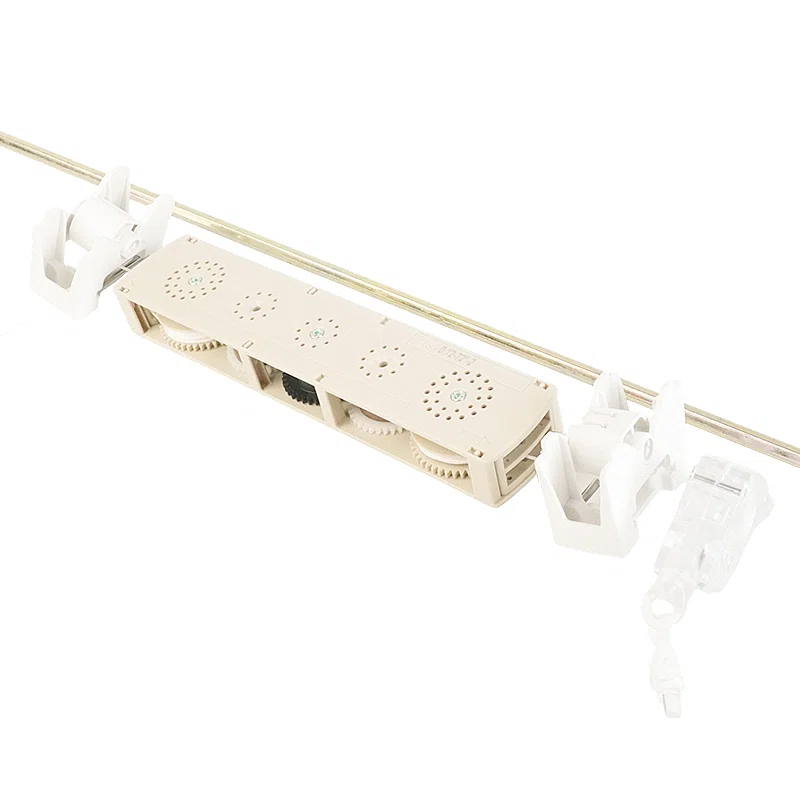
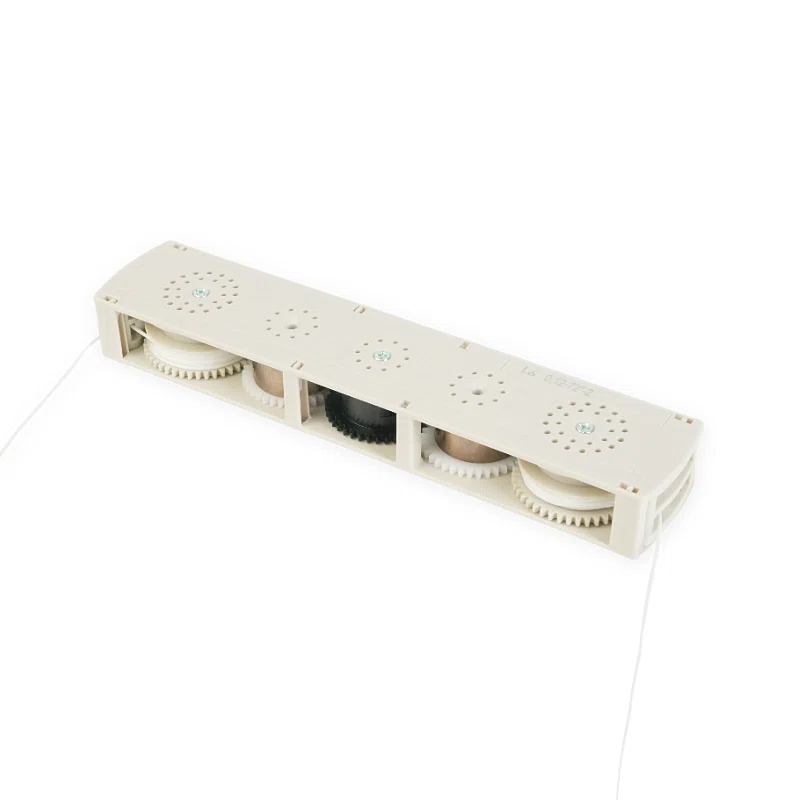
The DOSRON Low-Friction Wand Tilt Braking System is an OEM-ready tilter module engineered for heavy-duty cordless horizontal blinds (aluminum or faux-wood Venetians). It combines a low-drag gear train with a tunable anti-free-spin brake, so wide slat stacks can tilt smoothly without runaway rotation, wand “whip,” or slat drift. The result is a more premium feel, fewer service callbacks, and easier QC at scale.
What This System Solves (Why Tilt Braking Matters on Heavy Blinds)
On heavy-duty horizontals, the slat pack stores inertia. When a standard wand tilter has too little resistance, you’ll see three annoying field symptoms: runaway rotation (slats overshoot), bounce-back (slats creep after you stop), and wand snap (the wand rebounds, feels cheap, and can rattle the headrail). A proper braking tilter adds controlled resistance without turning the wand into a gym workout.
How Low-Friction + Brake Can Coexist (Engineering Overview)
1) Low-Drag Drive Path
- Optimized gear geometry to reduce mesh losses and keep tilt motion linear.
- Low-friction bearing points (bushing or bearing-ready journals) to reduce squeak and “grainy” feel.
- Material pairing strategy (e.g., engineering polymer on polymer, or polymer on treated metal) to reduce stick-slip.
2) Anti-Free-Spin Brake (Controlled Resistance)
- Preload-based friction brake that resists back-driving from slat inertia.
- Tunable brake torque so the same platform can cover light aluminum slats up to heavier faux-wood builds.
- Damping against overshoot for precise “stop-where-you-want” slat angles.
3) Cordless-Friendly Architecture
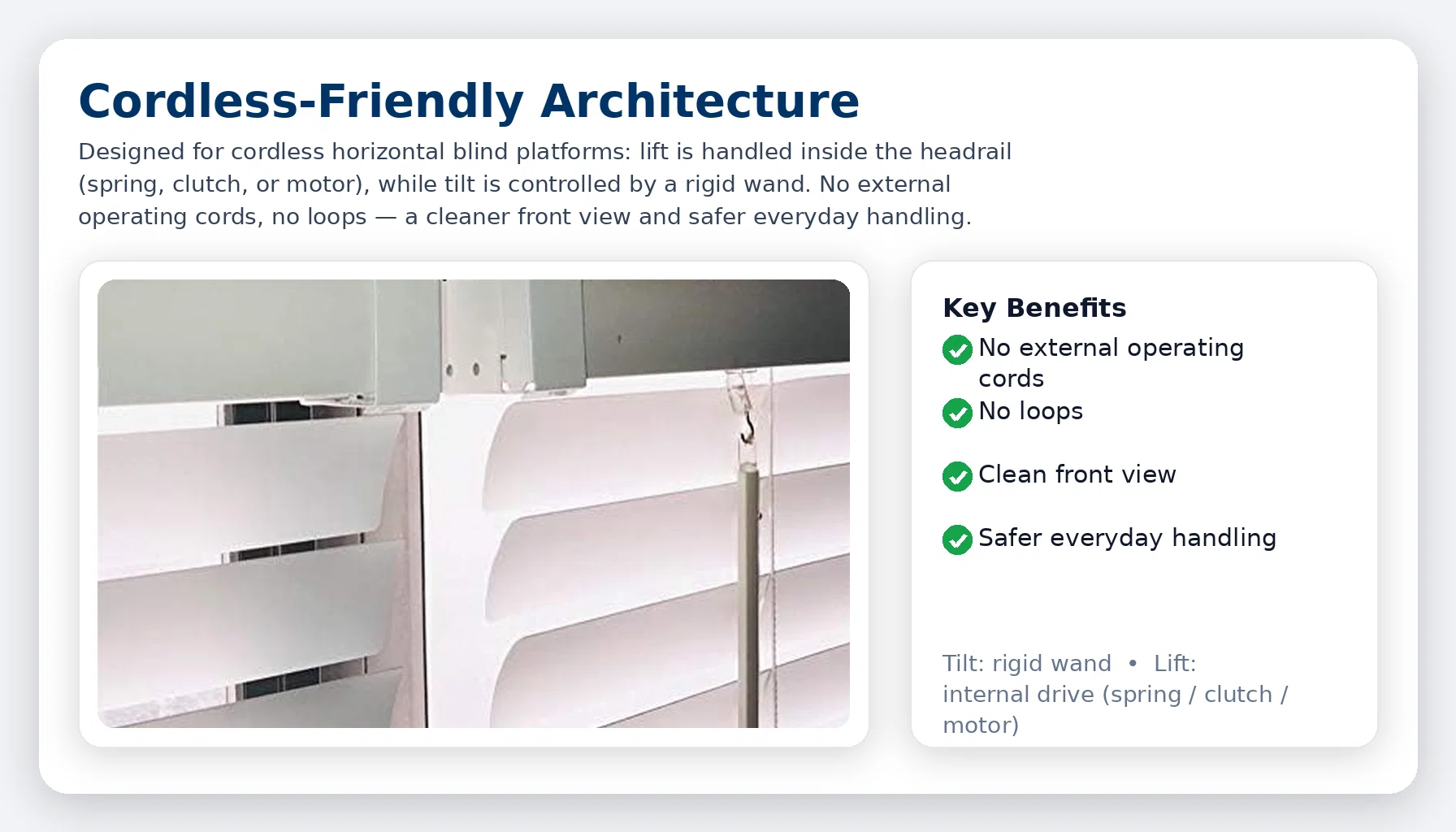
This tilter is designed for cordless horizontal blind platforms where lift is handled by an internal mechanism (spring, clutch, or motor), and tilt is handled by a rigid wand—no external hanging cords, no loops, cleaner front view, and safer everyday handling.
Where It Fits Best
- 2″ (50mm) faux-wood horizontals in large widths where slat inertia causes overshoot.
- 25–50mm aluminum Venetians requiring stable, quiet tilt for residential or commercial interiors.
- Projects that prioritize “premium feel”: hospitality, offices, healthcare, education, and high-rise residential.
Key Benefits (What Your Customers Actually Feel)
| Smoother wand motion | Lower starting friction helps users tilt with consistent effort, reducing “stutter” and stick-slip. |
| No runaway tilt | Brake prevents free-spin when the slat pack pushes back, so angle control stays precise. |
| Less rattle & fewer noise complaints | Controlled deceleration reduces end-of-travel “knock,” and stable interfaces reduce chatter. |
| Fewer after-sales adjustments | Brake torque can be matched to slat mass and ladder geometry, reducing drift and inconsistent tilt between units. |
OEM Customization Options
Mechanical Interfaces
- Wand connection: common wand profiles (hex/round) and lengths; anti-slip retention features optional.
- Headrail compatibility: adaptor geometry for your rail profile; left/right-hand variants supported.
- Ladder drum / tape interface: drum diameter and engagement details tuned to your ladder tape/cord system.
|
|
Brake Tuning
- Brake torque banding: set by friction pad material + preload + contact geometry.
- “Premium feel” tuning: lighter touch for residential, stronger damping for oversized commercial builds.
Materials & Finish
- Engineering polymers for low noise and stable dimensional control.
- Metal reinforcement options where you need higher stiffness at the mounting or shaft interface.
- Color matching for visible end components (white/black/gray or project-specific colors).
Technical Specifications (Configurable Ranges for Design-In)
Values below are typical design targets for heavy-duty horizontals; final specs are set by slat weight, ladder geometry, and your desired hand-feel.
| Parameter | Typical Range | Why It Matters |
|---|---|---|
| Brake torque (back-drive resistance) | ~0.08–0.35 N·m (tunable) | Prevents overshoot and slat angle creep on heavy slat packs. |
| Starting torque (user hand-feel) | Low/medium bands via material pairing + lubrication strategy | Reduces “sticky start” and improves perceived quality. |
| Tilt control | Stable 0–180° slat rotation (architecture-dependent) | Ensures consistent open/close and privacy control. |
| Noise behavior | Low-rattle design; damping features optional | Cuts chatter from tolerance stack-up and hard end-stops. |
| Durability target | 10,000–25,000+ tilt cycles (application-dependent) | Supports long life in daily-use residential and light commercial. |
| Operating environment | Typical indoor temperature/humidity bands | Maintains consistent feel and brake stability across seasons. |
Integration Notes for Cordless Horizontal Blind Platforms
- Keep tilt and lift “decoupled”: tilt braking should not add parasitic load to the lift stack.
- Control tolerance stack-up: headrail squareness and mounting stiffness directly affect friction and noise.
- Match brake to slat inertia: oversized faux-wood slats need more damping than thin aluminum slats.
- Assembly repeatability: set a brake-preload QC window so every unit feels the same out of the box.
Installation Overview (OEM Assembly-Friendly)
- Mount the tilter module into the headrail pocket and lock to the profile features.
- Connect ladder drums and verify alignment of ladder tape/cord paths.
- Attach wand interface (wand hook/clip/coupler) and check smooth motion through full tilt range.
- Verify brake performance: no free-spin, no bounce-back, and no abnormal squeak under load.
- Final QC: sample torque check + functional tilt test to confirm consistent hand-feel.
Quality & Validation (What We Recommend You Audit)
- Brake torque window: min/max limits to prevent “too loose” or “too stiff” field complaints.
- Noise screening: detect chatter from looseness/runout before shipment.
- Wear checks: friction pad glazing, dust sensitivity, and long-cycle drift of brake force.
- Packaging protection: prevent shaft/interface deformation that turns into friction spikes at install.
FAQ
1) Does a wand tilt system still count as “cordless”?
In most modern product language, “cordless” means no external hanging lift cords or bead chains. A rigid tilt wand is typically acceptable and is often preferred for safer, cleaner user interaction.
2) Will the brake make the wand harder to turn?
It adds controlled resistance, but the low-friction drive path keeps operation smooth. The goal is “premium damping,” not “stiff.” Brake torque is tuned to the slat weight band.
3) What’s the difference between “friction” and “braking” here?
Friction is the unwanted drag you feel everywhere; braking is the intentional resistance that prevents overshoot and back-drive. This system targets low friction + purposeful braking.
4) Can it help with squeak or chatter issues?
Yes—many squeaks come from stick-slip at contact points, and chatter often comes from looseness or intermittent contact. A stable, damped tilter reduces both failure modes when paired with correct tolerances.
5) Is this suitable for extra-wide faux-wood blinds?
That is one of the main use cases. Heavy slat inertia is exactly where anti-free-spin braking improves control and reduces bounce-back.
6) Can this be adapted to my existing headrail?
Usually, yes. OEM design-in typically needs the headrail pocket geometry and mounting features to match the module. Adaptor strategies are available to avoid a full platform redesign.
7) Does it work with different ladder types?
It can be configured for common ladder tape or ladder cord architectures by adjusting drum geometry and engagement details.
8) Do you offer lift motor options if a project needs motorized lift with a wand tilt?
Yes—some projects keep a wand for tilt while using a battery tubular motor for lift. If you want that mixed-control architecture, we can align the headrail/tube interfaces and provide a matching motor spec set.
Field Insight
On heavy-duty horizontals, tilt “feel” is a quality signal customers notice instantly. A well-tuned braking tilter is one of the simplest upgrades that can cut slat drift, overshoot, and rattle complaints—without changing your lift architecture. If your current platform sees inconsistent tilt force between batches, start by defining a brake-torque window and auditing tolerance stack-up at the headrail pocket, shaft journals, and ladder drum engagement.